Table of Contents
The home studio revolution has fundamentally transformed how we capture rhythm. In 2026, the line between live performance and digital production isn’t just blurred—it’s been completely redrawn by electronic drum sets that communicate directly with your DAW through a single USB cable. No more labyrinthine MIDI interfaces, no more latency-inducing workarounds; just pure, immediate translation of your stick work into editable MIDI data.
But here’s what most gear guides won’t tell you: not all USB MIDI drum sets are created equal when it comes to serious DAW tracking. The spec sheet might promise “class-compliant MIDI,” but the real-world experience can range from inspiring creative flow to a maddening exercise in troubleshooting dropped notes and unresponsive hi-hats. Whether you’re a producer looking to program realistic drum parts through live playing, a songwriter capturing ideas at 2 AM without waking the neighbors, or a seasoned engineer building a hybrid studio, understanding the nuanced interplay between hardware design and digital integration will make or break your investment.
Top 10 Electronic Drum Sets
Detailed Product Reviews
1. Donner DED-80 Electronic Drum Set with 4 Quiet Mesh Pads, 180+ Sounds, 2 Pedals, Throne, Headphones, Sticks, and Melodics Lessons

Overview: The Donner DED-80 is an entry-level electronic drum set designed for beginners and apartment dwellers. This complete package includes four 6-inch mesh drum pads, three 10-inch cymbals, a drum module, throne, headphones, sticks, and both kick and hi-hat pedals. The foldable metal frame expands to 42.5x18x39 inches, making it suitable for younger players and small spaces. The double-layered mesh heads provide realistic rebound while remaining quiet enough for apartment practice.
What Makes It Stand Out: The DED-80 excels as a learning tool with its powerful educational functions. It includes a built-in drum coach, 30 accompaniment tracks, and supports the Donner Play app plus Melodics lessons. The foldable design allows for easy storage when not in use. USB MIDI connectivity enables integration with DAW software for music creation, making it versatile beyond just practice.
Value for Money: For beginners, this kit offers exceptional value by including every necessary accessory. The 180 sounds and 15 drum kits cover essential genres, though serious players may eventually outgrow the library. Compared to renting or buying acoustic drums, it’s an affordable way to start drumming without disturbing neighbors. The included educational content adds significant value for self-taught drummers.
Strengths and Weaknesses: Pros include complete accessory package, educational features, quiet mesh heads, compact foldable design, and USB MIDI connectivity. Cons are the small 6-inch pads, limited 180-sound library, requirement for external amplifier, and basic single-zone pads that lack expressive depth. The kick pedal is a simple footswitch design rather than a tower.
Bottom Line: The DED-80 is an ideal starter kit for beginners in apartments. While it won’t satisfy advanced drummers, its educational focus, quiet operation, and all-inclusive package make it perfect for learning fundamentals without space or noise constraints.
2. Alesis Nitro Max Kit Electric Drum Set with Quiet Mesh Pads, 10" Dual-Zone Snare, Bluetooth, 440+ Authentic Sounds, Drumeo, USB MIDI, Kick Pedal
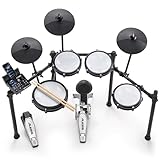
Overview: The Alesis Nitro Max Kit represents a significant step-up in the entry-level market, offering an 8-piece configuration with premium features. It boasts a 10-inch dual-zone mesh snare, three 8-inch mesh toms, a kick drum tower with pedal, and three 10-inch cymbals including a chokeable crash. The upgraded drum module features Bluetooth connectivity and industry-leading BFD drum sounds for professional-grade audio quality.
What Makes It Stand Out: This kit’s revolutionary drum module delivers 440+ authentic multi-velocity samples across 32 ready-to-play BFD kits, creating remarkably realistic acoustic drum sounds. The 10-inch dual-zone snare provides expressive rimshots and cross-stick capabilities rarely found at this price point. Bluetooth connectivity allows wireless streaming of play-along music, while the included 90-day Drumeo membership offers interactive lessons from 200+ professional drummers.
Value for Money: The Nitro Max hits a sweet spot between affordability and professional sound quality. The BFD sound engine alone justifies the price premium over basic kits, and the Drumeo subscription adds tremendous educational value. With 16 user-customizable kits, it grows with your skills without requiring immediate upgrades. The comprehensive sound library covers virtually every genre.
Strengths and Weaknesses: Pros include exceptional sound quality, large dual-zone snare, Bluetooth connectivity, comprehensive Drumeo lessons, and USB MIDI for DAW integration. The main drawbacks are the smaller 8-inch toms and limited 16 user kit slots compared to some competitors. The hi-hat pedal is a basic controller rather than a two-piece system.
Bottom Line: For serious beginners and intermediate players, the Nitro Max is the best value proposition available. It delivers professional-grade sounds and educational resources that accelerate skill development while remaining apartment-friendly.
3. AKLOT Acoustic-Style Electric Drum Set: Independent 16’’ Wooden Bass Drum and 12’’ Snare, Triple-Zone Ride Cymbal, Standalone Hi-Hat, Full Mesh Pads, 460 Sounds, USB MIDI, Throne, Sticks (B-CORE543)

Overview: The AKLOT B-CORE543 is a flagship electronic drum set that bridges the gap between electronic convenience and acoustic authenticity. This premium 9-piece kit features genuine wooden construction on the 16-inch kick drum and 12-inch snare, paired with a true two-piece independent hi-hat system and 14-inch triple-zone ride cymbal. The acoustic-style configuration delivers natural feel and response for demanding drummers seeking realistic playability.
What Makes It Stand Out: The independent wooden drums set this kit apart from typical all-rubber electronic sets. The 16-inch wooden kick provides 30% faster beater rebound and authentic acoustic punch, while the 12-inch dual-zone wooden snare captures subtle ghost notes and rimshots with studio precision. The two-piece hi-hat with weighted bottom cymbal tracks every foot splash and half-open articulation exactly like acoustic hardware, delivering unparalleled expression.
Value for Money: While priced higher than entry-level kits, the B-CORE543 delivers professional features at a fraction of flagship models from Roland or Yamaha. The 460 studio-sampled sounds, deep editing capabilities, and 20 user-customizable kits offer tremendous creative flexibility. For drummers seeking acoustic feel without acoustic volume, it represents excellent long-term investment value that won’t require immediate upgrades.
Strengths and Weaknesses: Pros include authentic wooden drum construction, independent two-piece hi-hat, triple-zone ride cymbal, comprehensive sound editing, and professional-grade samples. The larger footprint and higher price may challenge beginners, and the complex setup requires more space than compact kits. The wooden construction adds weight compared to all-mesh alternatives.
Bottom Line: The B-CORE543 is perfect for intermediate to advanced drummers transitioning from acoustic drums or seeking maximum expressiveness. Its authentic feel and professional features justify the premium for serious musicians who prioritize realistic response over budget constraints.
4. Donner DED-200 Electric Drum Sets with Quiet Mesh Drum Pads, 2 Cymbals w/Choke, 31 Kits and 450+ Sounds, Throne, Headphones, Sticks, USB MIDI, Melodics Lessons (5 Pads, 3 Cymbals)

Overview: The Donner DED-200 is an enhanced 8-piece electronic drum set that builds upon the DED-80 with larger pads and expanded capabilities. It features an 8-inch dual-zone mesh snare, three 8-inch mesh toms, a 6-inch kick drum tower, and three 10-inch cymbals including hi-hat, crash with choke, and ride. The kit includes a foldable iron stand, throne, headphones, sticks, and all necessary cables for immediate setup.
What Makes It Stand Out: With 450 sounds and 31 drum kits, the DED-200 offers substantially more sonic variety than its smaller sibling. The dual-zone snare enables rimshots and head articulation for more expressive playing. The built-in sequencer, metronome, and 50 play-along songs provide excellent practice tools, while the recording function lets you capture and evaluate your performances. Melodics lessons are included for structured learning.
Value for Money: The DED-200 positions itself as a compelling intermediate option, delivering nearly double the sounds of entry-level kits while maintaining an attractive price point. The inclusion of a dual-zone snare and chokeable cymbal adds professional touches typically reserved for higher-priced sets. Complete accessory inclusion eliminates hidden costs, making it a transparent value proposition for developing players.
Strengths and Weaknesses: Pros include extensive sound library, dual-zone snare, chokeable cymbal, comprehensive practice features, and sturdy foldable rack. The 6-inch kick drum feels small compared to acoustic bass drums, and the hi-hat control pedal lacks the realism of a two-piece system. Some users may desire larger tom pads, and the module interface can be less intuitive than premium brands.
Bottom Line: The DED-200 is an excellent intermediate kit for drummers ready to move beyond basic features. It balances affordability with expanded capabilities, making it ideal for developing players who need more expressive options without breaking the bank.
5. AKLOT Expanded-Size Electric Drum Set: 12’’ Two-Piece Standalone Hi-Hat, Independent Kick Drum and 10’’ Dual-Zone Snare, 12’’ Triple-Zone Ride Cymbal, All Mesh Heads, 460 Sounds, USB MIDI (B-CORE541)

Overview: The AKLOT B-CORE541 is a professional-grade 9-piece electronic drum set engineered for drummers prioritizing cymbal expression and dynamic control. It features a 10-inch dual-zone snare, three 8-inch dual-zone toms, an 8-inch kick tower, 12-inch two-piece independent hi-hat, 12-inch triple-zone ride cymbal, and 11-inch crash cymbals with choke. The reinforced H-frame rack ensures stability during intense performances.
What Makes It Stand Out: Every drum pad in this kit features dual-zone functionality, providing rim and head articulation across the entire set. The two-piece hi-hat system delivers three-stage triggering (open, half-open, closed) with precise foot splash detection that rivals acoustic hardware. The triple-zone ride cymbal offers separate bell, bow, and edge triggering for nuanced playing, while the adaptive silicone kick surface supports double pedals.
Value for Money: The B-CORE541 delivers professional expressiveness at a mid-range price point. With 460 high-quality sounds, 20 preset kits, and 20 user-customizable kits, it offers extensive tonal flexibility. The advanced hi-hat and cymbal functionality alone justifies the investment for drummers frustrated by limited electronic cymbal response in budget kits. The reinforced rack adds durability for long-term use.
Strengths and Weaknesses: Pros include dual-zone pads throughout, authentic two-piece hi-hat, triple-zone ride, sturdy H-frame rack, and comprehensive sound library. The 8-inch kick tower, while stable, lacks the acoustic feel of larger wooden kick drums found in higher-end models. The tom pads are modestly sized at 8 inches, and the module’s deep editing features have a learning curve.
Bottom Line: For drummers who prioritize cymbal work and expressive detail, the B-CORE541 is outstanding. Its advanced triggering systems and dual-zone pads make it ideal for intermediate players seeking professional-level dynamics without flagship pricing.
6. HAMPBACK MK-0 Electric Drum Set with 7’’ Quiet Mesh Drum Pads, 8’’ Full Rubber Cymbals, 12 Kits and 68 Authentic Sounds, USB MIDI, Throne, Sticks, Headphone, 2 Switch Pedals for Beginners & Kids

Overview:
The HAMPBACK MK-0 is an entry-level electronic drum kit designed for beginners and kids. It features four 7-inch mesh drum pads and three 8-inch rubber cymbals, along with 12 kits and 68 sounds. The package includes essential accessories like a throne, sticks, headphones, and two switch pedals. Its compact, foldable rack and power bank compatibility make it highly portable for practice anywhere.
What Makes It Stand Out:
The MK-0’s true differentiator is its power bank compatibility, liberating drummers from wall outlets for outdoor sessions. The double-layer mesh pads offer quieter practice than rubber alternatives, while the 2-year warranty provides exceptional peace of mind at this price point. The weekend warrior-friendly design with car trunk portability is genuinely practical.
Value for Money:
Positioned in the budget tier, this kit delivers remarkable value by including all necessary accessories and offering features typically found in pricier models. The warranty alone justifies the investment for cautious parents. While 68 sounds is modest, the quality suffices for early learning stages.
Strengths and Weaknesses:
Strengths: Ultra-portable design; power bank operation; quiet mesh heads; comprehensive accessory bundle; generous 2-year warranty.
Weaknesses: Limited 68-sound library; rubber cymbals lack realism; smaller 7" pads; basic module features.
Bottom Line:
Perfect for young beginners and families prioritizing portability and quiet operation. The MK-0 is a solid starter kit that removes barriers to entry with its thoughtful design and warranty protection.
7. AODSK Electric Drum Set for Beginner with 150 Sounds,4 Quiet Drum Pads,2 Pedal,Throne,Sticks,Electronic Drum with Headphone,AED-400

Overview:
The AODSK AED-400 is a complete electronic drum solution for novices, featuring four 6.5-inch pads and three 8-inch cymbals. With 150 sounds, 15 drum kits, and 10 demo songs spanning multiple genres, it provides substantial sonic variety. The package includes a foldable metal frame, drum module, throne, sticks, headphones, and cables—everything needed for immediate practice.
What Makes It Stand Out:
The AED-400 distinguishes itself with triple the sound library of many budget competitors. Its AUX input and USB MIDI connectivity enable seamless integration with music apps and DAWs. The built-in metronome and LED display enhance practice sessions, while the lightweight design facilitates transport between home, lessons, or outdoor performances.
Value for Money:
This kit punches above its weight class by delivering 150 high-quality sounds at an entry-level price. The inclusion of a sturdy metal frame rather than plastic adds durability uncommon in this segment. While cymbals are rubber rather than silicone, the overall package represents excellent value for beginners testing their commitment.
Strengths and Weaknesses:
Strengths: Extensive 150-sound library; durable metal frame; USB MIDI/AUX connectivity; built-in metronome; highly portable.
Weaknesses: Single-zone rubber cymbals; smaller 6.5" pads; limited module editing; no dual-zone snare.
Bottom Line:
An exceptional value proposition for beginners wanting variety without complexity. The AED-400 offers substantial room to grow sonically while maintaining the simplicity newcomers need.
8. Donner Electric Drum Set, DED-70 Electronic Drum Kit for Beginner with 150 Sounds, 4 Quiet Mesh Pads, 9" Cymbals, USB MIDI, Type-C Charging, 2 Pedal, Throne, Headphones, Sticks, Melodics Lessons

Overview:
The Donner DED-70 targets young learners aged 6-14 with its upgraded 7-piece configuration. It features four 6.5-inch dual-layer mesh drum heads and three oversized 9-inch silicone cymbals for enhanced realism. The module includes 150 sounds, 15 customizable kits, and 10 demo songs. Type-C charging and power bank compatibility support flexible practice locations.
What Makes It Stand Out:
The DED-70’s 9-inch silicone cymbals significantly outperform the rubber cymbals common in this price range, providing more authentic response and feel. The inclusion of Melodics lessons offers structured learning, while the ergonomic, height-adjustable rack grows with young players. Type-C charging modernizes the power experience.
Value for Money:
Slightly premium over basic budget kits, the DED-70 justifies its cost through superior cymbal quality, dual-layer mesh heads, and educational content. The adjustable frame extends usable lifespan through growth spurts. Parents will appreciate the apartment-friendly noise levels and future-proof connectivity.
Strengths and Weaknesses:
Strengths: Large 9" silicone cymbals; dual-layer mesh heads; height-adjustable rack; Type-C/power bank charging; Melodics lessons included.
Weaknesses: Requires external amplifier for speakers; limited to 150 sounds; smaller pad size; primarily youth-focused sizing.
Bottom Line:
Ideal for serious young beginners, the DED-70 bridges the gap between toy and instrument. Its quality components and educational features make it worth the modest price increase over basic entry-level alternatives.
9. Alesis Nitro Pro Electric Drum Set with Dual-Zone Quiet Mesh Pads, 500+ Authentic BFD Sounds, Bluetooth, Drumeo, USB MIDI, Double Kick Compatible

Overview:
The Alesis Nitro Pro elevates the beginner experience to professional standards with its 8-piece configuration. It features a dual-zone 10-inch mesh snare, three 8-inch mesh toms, and 10-inch cymbals with choke functionality. The upgraded module packs 500+ BFD sounds across 36 preset kits, plus Bluetooth connectivity. A 90-day Drumeo membership provides expert interactive lessons.
What Makes It Stand Out:
The Nitro Pro’s BFD multi-velocity samples deliver unmatched acoustic realism for this price tier. Dual-zone pads unlock rimshots and advanced articulations, while the double kick-ready tower supports evolving techniques. Bluetooth audio streaming allows playing along with tracks wirelessly, and the included Drumeo subscription offers structured learning from world-class instructors.
Value for Money:
Positioned as a mid-range kit, it justifies every dollar by eliminating the typical beginner-to-intermediate upgrade cycle. The BFD library rivals software costing hundreds alone, and the Drumeo membership adds exceptional educational value. Serious students gain professional tools that remain viable for years.
Strengths and Weaknesses:
Strengths: Professional BFD sound engine; dual-zone mesh pads; double kick compatibility; Bluetooth connectivity; Drumeo lessons; chokable cymbals.
Weaknesses: Higher price; steeper learning curve; larger footprint; some non-metal hardware.
Bottom Line:
For committed learners seeking professional-grade features from day one, the Nitro Pro is unbeatable. It bridges the gap between practice and performance, making it a future-proof investment that grows with your ambition.
10. Donner DED-80 Electric Drum Kit with 4 Quiet Mesh Pads, 180+ Sounds, 30 Demo Songs, 10" Cymbals, 2 Pedals, Throne, Headphones, Sticks, USB MIDI, Melodics Lessons, White
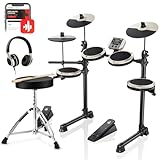
Overview:
The Donner DED-80 completes the brand’s beginner lineup with a feature-rich package suitable for teens and adults. It includes four 6-inch dual-layer mesh pads, three 10-inch cymbals, and a comprehensive sound module offering 180+ sounds, 15 customizable kits, and 30 demo songs. The white finish distinguishes it aesthetically, while the included Melodics lessons support structured learning.
What Makes It Stand Out:
The DED-80’s 30 demo songs double typical offerings, providing extensive play-along material. Its intelligent dynamic clarity technology enhances sound realism, while the larger 10-inch cymbals improve playing feel. The drum coach function and skill-building exercises create a guided practice environment rarely seen at this price. The white color option appeals to style-conscious players.
Value for Money:
This kit offers premium learning features without premium pricing. The expanded sound library and demo collection provide variety that sustains interest, while the educational tools accelerate progress. Though requiring an external amplifier, the headphone option delivers silent practice immediately. It’s competitively priced against kits with fewer features.
Strengths and Weaknesses:
Strengths: 180+ sound library; 30 demo songs; drum coach function; large 10" cymbals; Melodics lessons; stylish white design; dual-layer mesh.
Weaknesses: Requires external amplifier; smaller 6" pads; limited advanced features; white finish shows dirt easily.
Bottom Line:
The DED-80 excels as a learning-focused kit for dedicated beginners. Its educational features and expanded content library make it ideal for self-motivated students seeking rapid improvement in apartment-friendly format.
The Evolution of USB MIDI in Electronic Drums
The journey from 5-pin DIN cables to plug-and-play USB connectivity represents more than just a change in physical connectors. Early electronic drums treated MIDI as an afterthought—a simple trigger output that required dedicated interfaces and suffered from significant timing inconsistencies. Modern USB MIDI integration, particularly in 2026’s crop of electronic drum sets, embeds the MIDI interface directly into the drum module’s chipset, creating a direct digital pathway to your computer.
This evolution matters because it eliminates an entire layer of potential failure points. When your drum module connects via USB, it’s essentially becoming a specialized audio interface optimized for ultra-low latency trigger-to-data conversion. The module’s internal clock synchronizes with your DAW’s timeline, enabling sample-accurate recording of your performances. Understanding this shift helps you appreciate why features like driver stability and firmware update protocols are just as critical as pad feel.
From Class-Compliant to Proprietary Drivers
Class-compliant MIDI devices work immediately without installing drivers, which feels magical until you hit the limitations. Many entry-level electronic drum sets use generic chipsets that prioritize compatibility over performance. Professional-grade kits often ship with optional proprietary drivers that unlock lower latency and advanced features like high-resolution velocity curves and polyphonic aftertouch for cymbal swells. The trade-off? You’re locked into the manufacturer’s driver support lifecycle, which becomes crucial when macOS or Windows pushes a major update.
Why USB MIDI Matters for Modern Producers
Direct DAW integration transforms your electronic drum set from a practice tool into a legitimate production instrument. When you can record MIDI directly into your session, you preserve every nuance of your performance—ghost notes, flams, cymbal chokes—in a format that’s completely editable without losing the human feel. This capability fundamentally changes your workflow, allowing you to comp takes, quantize selectively, and experiment with different virtual drum kits long after you’ve recorded the initial performance.
The real power emerges when you combine USB MIDI with the multi-channel audio outputs many modern modules offer. You can record the MIDI data for editing flexibility while simultaneously capturing the module’s internal sounds as audio stems for immediate reference or final use. This dual-path approach gives you the best of both worlds: the realism of acoustic modeling and the infinite sound-shaping possibilities of software instruments.
The Creative Loop Advantage
Unlike programming drums with a mouse or pads, playing parts live creates happy accidents. A slightly rushed fill, an unintentional accent, or the natural variation in your hi-hat footwork—these imperfections breathe life into sterile digital productions. USB MIDI preserves these micro-timing variations at resolutions up to 960 PPQN (pulses per quarter note), capturing subtleties that would be lost in traditional step sequencing. Your DAW becomes a tape machine for your drumming, not just a grid editor.
Understanding Latency: The Silent Productivity Killer
Latency in electronic drums isn’t just about hearing a delayed sound—it’s about the disconnect between your muscle memory and the auditory feedback. At 10ms of round-trip latency, most drummers report feeling “off.” At 5ms, the experience becomes transparent. The magic number for professional tracking? Under 3ms total latency from stick impact to sound output.
Achieving this requires understanding the entire signal chain: pad trigger time, module processing, USB transmission, DAW buffer handling, and audio interface output. Your electronic drum set’s USB MIDI performance is only as good as the weakest link in this chain. Many producers blame their drums when the real culprit is an audio interface running at 1024-sample buffers or a DAW plagued by plugin latency.
Measuring Real-World Latency
Don’t trust manufacturer specs. Use your DAW’s built-in latency measurement tools or third-party utilities to measure the actual round-trip time. The process is simple: create a click track, record it through your drum module’s trigger inputs (if available), and measure the offset between the original and recorded waveforms. This reveals the true latency, which often differs significantly from advertised numbers due to system-specific variables like USB controller chipsets and motherboard architecture.
Sample Rate and Bit Depth: Technical Foundations
Your electronic drum set’s USB MIDI connection handles note data, but the audio outputs (if you’re using them) operate on different principles. Most modules output audio at 44.1kHz/16-bit by default, matching CD quality but potentially limiting dynamic range for serious production. Higher-end kits offer 48kHz/24-bit output, which provides headroom for post-processing and better compatibility with film and video workflows.
The MIDI specification itself doesn’t have sample rates, but the timing resolution is influenced by your DAW’s sample rate. At 96kHz, your MIDI timing becomes twice as precise compared to 48kHz because the sample clock runs faster. This matters for capturing ultra-fast double-bass patterns or intricate ghost note work where timing variations of a few milliseconds define the feel.
Clock Synchronization Strategies
When recording MIDI and audio simultaneously, clock drift between your drum module and audio interface can cause phase issues and timing slop. The solution is word clock synchronization, either through digital audio connections (S/PDIF, ADAT) or by using your drum module as the master clock source via USB. Many modern DAWs can sync to an external MIDI clock, ensuring your drum performance and other tracks remain locked throughout long sessions.
Multi-Zone Pads vs. Single-Zone: Creative Implications
A single-zone snare pad sends one MIDI note regardless of where you strike it. A dual-zone pad sends different notes for the head and rim, enabling side-stick sounds and rimshots. Triple-zone pads add a bell zone for ride cymbals, while advanced multi-zone pads can detect positional sensing—mapping different samples across the pad’s surface based on strike location.
For DAW tracking, multi-zone pads exponentially increase your expressive palette without adding more physical pads. You can assign different articulations of the same drum to different zones, then edit them independently in your DAW. A rimshot might trigger a processed, compressed sample while the head triggers a natural, room-miked sound—blended perfectly in the mix.
Positional Sensing and MIDI CC
High-end snare and tom pads feature positional sensing that sends continuous controller (CC) data based on where you hit the drum. This allows virtual instruments to crossfade between center and edge samples in real-time, mimicking the tonal variation of acoustic drums. When evaluating electronic drum sets, check if positional sensing data is transmitted via USB MIDI or only used internally by the module. Some budget kits calculate position in the module but don’t output the CC data, limiting your software control.
Mesh Heads vs. Rubber Pads: Feel Meets Function
The debate between mesh heads and rubber pads extends beyond comfort—it directly impacts your tracking consistency. Mesh heads, typically made from woven polymer fibers, provide an acoustic-like rebound that encourages proper technique. This translates to more consistent velocity values and better dynamic control in your DAW recordings. Your muscle memory develops around realistic stick response, which pays dividends when you transition to acoustic drums for live shows.
Rubber pads, while more durable and less expensive, have a different rebound characteristic that can cause fatigue during long sessions. More importantly, the harder surface can produce “hot spots”—areas of the pad that trigger at maximum velocity with relatively light hits. This creates inconsistent MIDI data that requires extensive velocity curve editing in your DAW.
Tension Adjustability and Sensitivity Calibration
Quality mesh-head pads allow tension adjustment, letting you fine-tune the rebound to match your playing style. This isn’t just about comfort; proper tension ensures the trigger sensor responds evenly across the entire head surface. When setting up for DAW tracking, spend time calibrating each pad’s sensitivity threshold and velocity curve in the module’s settings. A pad that’s too sensitive will pick up stick vibrations and double-trigger, while one that’s not sensitive enough will miss ghost notes.
Hi-Hat Controller Realism: The Nuance Frontier
The hi-hat is the most complex trigger to get right. A basic electronic hi-hat uses a simple foot pedal that sends open or closed states. Advanced controllers use continuous position sensing, sending CC values from 0-127 as you move the pedal, enabling half-open splashes and foot chick sounds. For DAW tracking, this continuous data is gold—you can automate the CC lane in your DAW to adjust the hi-hat opening after recording, fixing that slightly-too-open hat on the chorus without re-tracking.
The physical design matters enormously. Some hi-hat controllers use a mechanical linkage that feels like an acoustic hi-hat; others use a simple spring-loaded pedal that bears little resemblance. The realistic feel isn’t just about comfort—it affects your timing and dynamics. When your footwork feels natural, your hi-hat patterns groove better, and the MIDI data reflects that musicality.
Foot Splash and Chick Articulations
Professional electronic drum sets distinguish between foot splashes (quick pedal openings) and chick sounds (closing the hats with your foot). These are separate MIDI notes or CC commands. When mapping to software instruments, ensure your virtual drum library supports these articulations. Superior Drummer, Addictive Drums, and BFD3 all have extensive hi-hat mapping options, but they require your drum set to send the correct MIDI implementation chart data.
Cymbal Choking and Articulation: Expressive Control
Grabbing a cymbal to choke it is a fundamental drumming technique that adds punctuation to musical phrases. Electronic cymbals detect chokes through pressure sensors in the bell area. When you grab the cymbal after striking it, the module sends a MIDI note-off command or a specific choke MIDI note. This simple action transforms static loops into dynamic performances.
Beyond choking, advanced cymbals support bell, bow, and edge zones, each sending distinct MIDI notes. Some even detect stick angle, sending different data for shank hits versus tip hits. For DAW tracking, this means you can record a single cymbal performance that contains multiple articulations, then treat each zone as a separate track in your mix—applying different EQ, compression, or effects to the bell hits versus the edge crashes.
Swing Time and Cymbal Crescendos
The way electronic cymbals handle repeated strikes during crescendos reveals their quality. Budget cymbals suffer from “machine-gunning”—the same sample triggering repeatedly, sounding fake. Better systems use round-robin sample triggering, alternating between multiple samples of the same articulation. The best systems layer velocity crossfading with round-robin selection, creating cymbal builds that sound indistinguishable from acoustic performances. This data fidelity is preserved through USB MIDI, giving your DAW the raw material for authentic-sounding crescendos.
Module Brain Power: Processing and Connectivity
The drum module is the computer that translates physical strikes into digital data. Its processor speed determines how quickly it can analyze incoming trigger signals and generate MIDI messages. A sluggish module introduces timing jitter—microscopic variations in when MIDI notes are sent relative to the actual strike. This jitter, measured in microseconds, can accumulate and make your tracks feel slightly “off” even when quantized.
Look for modules with dedicated trigger processors separate from the main CPU. This architecture ensures that timing-critical functions aren’t delayed by UI rendering or audio playback tasks. USB 3.0 connectivity, while not always necessary for MIDI bandwidth, provides better power delivery and more stable connections compared to USB 2.0, reducing the chance of disconnects during critical takes.
Internal Memory and Preset Management
Modern modules store user kits, custom samples, and trigger settings in flash memory. For DAW tracking, the ability to create kits specifically optimized for MIDI output is invaluable. You might want a kit with extreme dynamic range for orchestral work, or a compressed, limited kit for metal production. Modules with ample user memory let you save multiple MIDI-optimized kits and switch them instantly without reprogramming. Some even allow per-pad MIDI note assignment, letting you create custom maps that match your favorite software instruments perfectly.
Expandability and Future-Proofing Your Investment
Electronic drum sets are modular by nature, but USB MIDI capabilities can vary between the main pads and any expansion pads you add later. Before purchasing, verify that the module’s USB MIDI implementation supports the maximum number of pads and zones you might want in the future. Some modules limit USB MIDI to the first 16 triggers, requiring additional triggers to use the traditional 5-pin MIDI output instead.
Consider the physical expandability too. Does the module have enough trigger inputs for additional cymbals or percussion pads? Are the inputs dual-zone capable? Can you add a second crash cymbal or a splash without buying a new module? The best setups grow with your needs, and USB MIDI should seamlessly incorporate new triggers without requiring complex reconfiguration.
Firmware Update Philosophy
Manufacturers approach firmware updates differently. Some release regular updates that add features, improve USB stability, and expand MIDI capabilities. Others treat the module as static hardware, never updating it post-release. Research the manufacturer’s track record. A company that actively supports its products with firmware updates is more likely to fix USB compatibility issues when Apple releases a new macOS version or Microsoft changes Windows’ driver model. This ongoing support is the difference between a five-year investment and a ten-year studio workhorse.
Stand Stability and Ergonomics: The Overlooked Essentials
A wobbly stand doesn’t just feel unprofessional—it introduces mechanical noise that can bleed into overhead mics if you’re recording acoustic elements simultaneously, and it affects your playing consistency. When a stand shifts slightly between sessions, your pad positions change, altering your stick angles and thus your velocity consistency. This creates MIDI data that varies unpredictably, complicating editing.
The ergonomics of your setup directly influence your performance’s musicality. Pads positioned too high or low force you to adjust your technique, creating unnatural velocity curves. A hi-hat stand that’s too far from the snare disrupts your muscle memory for common patterns. For DAW tracking, where consistency is king, invest time in setting up your stand to match acoustic drum dimensions. Use a tape measure to position pads according to standard acoustic drum measurements—your muscle memory will thank you, and your MIDI data will show it.
Isolation from Floor Vibrations
If you’re recording in a room with wooden floors or near HVAC systems, vibrations can travel up the stand and trigger pads inadvertently. This creates phantom MIDI notes that pollute your recordings. Professional setups use isolation mounts or place stands on dense rubber mats to decouple them from the floor. Some high-end stands feature built-in isolation systems. When tracking delicate passages with lots of ghost notes, this isolation prevents false triggers that would otherwise require tedious editing to remove.
Software Integration: Beyond Basic MIDI Mapping
The best electronic drum sets for DAW tracking come with companion software that extends their capabilities. These applications might offer visual velocity curve editors, where you can draw custom response curves that are uploaded to the module. Others provide deep integration with specific DAWs, automatically creating tracks and assigning virtual instruments when you connect the drums.
Look for MIDI Learn functionality in both the drum module and your DAW. This lets you assign MIDI controls from the drum set—like the hi-hat pedal or a pad edge—to any parameter in your software. Imagine controlling reverb send levels with your hi-hat pedal: closed hat sends less reverb, open hat drenches it in space. This transforms your drum set from a simple trigger controller into a full performance instrument that shapes the mix as you play.
Custom MIDI Implementation Charts
Every electronic drum set follows a MIDI implementation chart that defines which notes correspond to which pads and articulations. Advanced users can create custom charts in their DAW’s drum editor to match their specific module perfectly. Some modules allow you to edit the MIDI note numbers directly, enabling you to align with the General MIDI drum map or create completely custom layouts. This flexibility is crucial when working with niche virtual instruments that use non-standard mapping.
Budget Allocation Strategies: Where to Invest
When building a DAW-centric electronic drum setup, allocate your budget based on what actually impacts recording quality. The module’s USB MIDI implementation and processing power are non-negotiable—a weak module ruins the signal chain before it even reaches your computer. Next, prioritize multi-zone pads for snare and ride cymbal, as these provide the most creative flexibility. Hi-hat controller quality comes third; a realistic pedal is worth its weight in gold for believable performances.
Cymbal quality often gets overlooked in favor of more tom pads, but for DAW tracking, a few excellent cymbals outperform many mediocre ones. Chokeable, multi-zone cymbals provide articulation data that makes software instruments sound alive. Tom pads can be single-zone without severely limiting expression, especially if you’re using software that doesn’t distinguish between head and rim strikes on toms anyway.
The Hidden Costs of Connectivity
Factor in the cost of quality USB cables. A $5 cable might work for printers, but for low-latency MIDI transmission, shielding and connector quality matter. Budget for a powered USB hub if your computer has limited ports—bus-powered hubs can introduce voltage fluctuations that cause MIDI dropouts. Consider a USB isolator if you experience ground loop hum when connecting both USB MIDI and audio outputs to your computer. These small investments prevent session-ruining technical problems.
Common Setup Pitfalls and How to Avoid Them
One of the most frustrating issues is MIDI note doubling, where a single strike triggers two notes in your DAW. This usually stems from incorrect crosstalk settings in the drum module. When you hit the snare hard, vibrations travel through the stand and trigger the nearby tom pad. The module’s crosstalk cancellation should suppress these ghost triggers, but set it too aggressively and you’ll miss legitimate rimshots. The solution is methodical calibration: strike each pad individually, adjust sensitivity until only intentional hits register, then test crosstalk settings by playing full-kit patterns.
Another common problem is inconsistent velocity response across pads. You might hit the snare and crash at the same force, but the snare triggers at velocity 100 while the crash hits 80. This makes mixing difficult because you can’t apply consistent velocity-based processing. Fix this by creating a reference velocity map: play each pad with consistent medium-force hits, note the average velocity in your DAW, then adjust each pad’s gain in the module until they all average the same velocity value.
USB Buffer Optimization
Your DAW’s USB buffer settings affect MIDI timing as much as audio latency. Too large a buffer, and your MIDI notes arrive late. Too small, and you risk dropouts. The sweet spot varies by system, but start at 128 samples for MIDI tracking. Record a simple pattern, then zoom into the MIDI notes in your DAW and check if they align with the grid consistently. If notes drift early or late, adjust the buffer size and retest. Some DAWs offer a “MIDI only” buffer setting separate from audio buffers—use this if available to optimize MIDI performance without affecting audio stability.
Frequently Asked Questions
How do I know if my computer will work with a USB MIDI drum set?
Virtually all modern computers support class-compliant USB MIDI devices. For Windows, ensure you’re running Windows 10 or later with the latest updates. Mac users need macOS 10.15 or newer. Test your system’s USB stability by connecting other MIDI devices and monitoring for dropouts during long sessions. If you’re using an older machine, consider a dedicated PCIe USB card with independent controllers for each port to avoid bandwidth contention.
What’s the difference between MIDI over USB and MIDI over Bluetooth for DAW tracking?
Bluetooth MIDI introduces 7-15ms of additional latency compared to USB, making it unsuitable for precise tracking. While convenient for wireless control of DAW transport functions, Bluetooth should never be used for recording drum performances where timing feel is critical. USB provides a wired, stable connection with sub-3ms latency potential and doesn’t suffer from wireless interference or pairing issues that can disrupt sessions.
Can I use multiple USB MIDI devices simultaneously in my DAW?
Yes, most DAWs support multiple MIDI devices, but you need to manage them carefully. Each device appears as a separate MIDI port. Create a device aggregation in macOS Audio MIDI Setup or use a MIDI utility like MIDI-OX on Windows to rename devices and prevent confusion. Be mindful of clock sync—designate one device, typically your audio interface, as the master clock source to prevent timing drift between devices.
Why do my hi-hat pedals feel different in my DAW than in the drum module?
This discrepancy usually occurs because your virtual instrument’s hi-hat implementation differs from your module’s MIDI output. Check the MIDI CC number your module sends for pedal position (typically CC4) and ensure your software instrument is mapped to receive it. Some instruments require you to manually enable “continuous hi-hat control” in their settings. Additionally, calibrate the pedal range in your drum module to ensure it uses the full 0-127 CC range.
How many pads can I trigger via USB MIDI before hitting limitations?
The MIDI specification supports 16 channels with 128 notes each, but USB MIDI can handle far more data than traditional 5-pin connections. Practical limits depend on your module’s processing power. Most professional modules can handle 20-30 triggers with full zone support over USB before timing jitter becomes noticeable. If you’re building a massive setup, consider modules with dual USB ports—one for MIDI, one for auxiliary data—or split your kit across two modules.
Should I record MIDI and audio from the module simultaneously?
Absolutely. Recording both provides a safety net and creative flexibility. The audio track serves as a reference for feel and timing, especially when editing MIDI later. It also gives you the module’s internal sounds as a production option. Record the audio through your main interface for quality, not the module’s headphone output. Keep the audio and MIDI tracks grouped in your DAW for easy comping and editing.
What causes random MIDI note dropouts during recording?
Dropouts stem from three main sources: insufficient USB power, driver conflicts, or buffer underruns. Use a powered USB hub or connect directly to a motherboard USB port—not a front-panel case port. Close background applications that might access MIDI devices, like lighting control software or system utilities. Increase your DAW’s MIDI buffer size incrementally until dropouts cease, then optimize other settings to maintain low latency.
Can I use my electronic drums to control non-drum virtual instruments?
Yes, and this opens creative possibilities. Map pads to trigger synth samples, launch clips in Ableton Live, or control effects parameters. Use the hi-hat pedal as an expression controller for filter cutoff. Assign the ride cymbal bell to trigger a bass drop. Most DAWs allow MIDI note mapping and MIDI Learn functionality that makes these reassignments simple. Save these alternate maps as DAW templates for different production scenarios.
How often should I recalibrate my pads for consistent DAW tracking?
Recalibrate monthly for heavy use, or whenever you notice velocity inconsistencies. Temperature and humidity changes affect pad sensitivity, especially mesh heads that expand and contract. Always recalibrate after transporting your kit, even if it’s just across the room. Keep a calibration log in your DAW’s project notes—record the date and any settings changes so you can restore previous configurations if a new calibration doesn’t work as expected.
Will upgrading my drum module improve USB MIDI performance if I keep the same pads?
Often, yes. The module’s trigger processing algorithms and USB chipset quality significantly impact MIDI data accuracy. A higher-end module can provide better crosstalk cancellation, more precise velocity measurement, and lower timing jitter with the same physical pads. However, the pads’ mechanical limitations remain—upgrading from rubber to mesh pads will improve feel and consistency more than a module upgrade alone. For DAW tracking, prioritize module quality first, then pad upgrades as budget allows.
See Also
- 10 Electronic Drum Sets With USB MIDI for Home Recording in 2026
- 10 Premium Electronic Drum Sets for Studio Recording in 2026
- 10 Junior Electronic Drum Sets with Game Apps in 2026
- 10 Electronic Drum Sets with Mesh Heads That Feel Like Acoustic Skins in 2026
- 10 Affordable Electronic Drum Sets for Bedroom Producers in 2026