Table of Contents
The sidewalk is your stage, the passing crowd your audience, and that hat at your feet? That’s your ticket to tomorrow’s coffee and maybe next month’s rent. When you’re busking, there’s no setlist taped to your guitar case and no sound engineer to bail you out. You’re three chords into a Neil Young classic when someone shouts for something in G instead of E. The coins are dropping, the moment is hot, and you’ve got exactly four seconds to make that transition before the magic fizzles. This is where a quick-release capo stops being a luxury and becomes your secret weapon.
Unlike studio musicians who can pause between takes, or stage performers with techs handing them pre-set instruments, buskers live and die by their ability to adapt in real-time. A standard screw-adjust capo might offer precision, but it’s about as practical as a tuning fork in a thunderstorm when you’re mid-performance. Quick-release mechanisms—whether spring-loaded triggers or innovative lever systems—let you clamp and release with one hand while your other hand never leaves the fretboard. But not all quick-release capos are created equal, and choosing the wrong one can mean the difference between a seamless key change and a catastrophic buzz that clears your audience faster than a rainstorm.
Top 10 Quick-Release Capos
Detailed Product Reviews
1. Kyser Quick-Change Guitar Capo for 6-string acoustic guitars, Silver, KG6SA

Overview: The Kyser Quick-Change capo represents the gold standard that revolutionized capo design decades ago. Engineered for 6-string acoustic guitars, this silver beauty combines robust construction with intuitive one-handed operation that working musicians demand. Its sleek aluminum body houses a powerful steel spring, delivering consistent pressure across the fretboard without requiring manual adjustment. The iconic design allows players to park it on the headstock when not in use, ensuring it’s always within reach during performances.
What Makes It Stand Out: As the original quick-change capo, Kyser’s pedigree is unmatched. The lifetime guarantee reflects supreme confidence in its durability, while the made-in-USA craftsmanship ensures quality control that overseas alternatives can’t match. The spring tension is precisely calibrated for acoustic guitars, eliminating buzzing while maintaining true intonation. Its ability to clamp securely to the headstock eliminates the frustration of misplaced gear during gigs.
Value for Money: Priced in the premium tier ($18-22), the Kyser justifies every penny through its lifetime warranty and bulletproof construction. While budget options may save $10 initially, they’ll likely need replacement within a few years. This capo essentially costs pennies per year over a lifetime of use, making it economically smarter than disposable alternatives.
Strengths and Weaknesses: Pros: Unparalleled durability; effortless one-handed operation; lifetime guarantee; parks on headstock; consistent pressure; made in USA. Cons: Higher upfront cost; spring may be too strong for some vintage necks; limited tension adjustability; silver finish shows wear over time.
Bottom Line: For serious acoustic guitarists who view their capo as a long-term investment rather than an accessory, the Kyser KG6SA remains the undisputed champion. Its proven reliability and lifetime guarantee make it the smart choice for performers and studio musicians alike.
2. Capo for 6-String Acoustic and Electric Guitar, Lightweight Quick Release Capo for Guitars, Ukulele, Bass, Mandolin, Banjo

Overview: This versatile capo delivers universal compatibility across a wide range of fretted instruments, from 6-string acoustics to ukuleles, mandolins, and banjos. Constructed from lightweight ABS plastic with a high-grade steel spring, it prioritizes portability and affordability without sacrificing core functionality. The quick-release mechanism enables seamless key changes with one hand, while the silicone padding protects delicate fretboard finishes from damage during aggressive playing sessions.
What Makes It Stand Out: The universal design sets this apart, eliminating the need for multiple specialized capos. Its internal memory spring maintains consistent pressure across different neck profiles, reducing tuning issues. The comprehensive money-back guarantee demonstrates manufacturer confidence, while the anti-corrosion properties ensure longevity despite the plastic construction. It’s a true multi-instrument solution for the modern musician’s toolkit.
Value for Money: Typically retailing under $10, this capo offers exceptional bang-for-buck. Beginners and casual players get professional-grade features—quick release, protective padding, and buzz-free performance—at a fraction of premium brand prices. While it may not outlast metal alternatives, the cost-to-performance ratio makes it an intelligent entry-level purchase.
Strengths and Weaknesses: Pros: Extremely affordable; ultra-lightweight; works on multiple instruments; protective silicone padding; money-back guarantee; corrosion-resistant. Cons: ABS plastic less durable than metal; spring tension not adjustable; generic brand support uncertain; may slip on 12-string guitars.
Bottom Line: Perfect for beginners, multi-instrumentalists, or as a backup, this capo proves you don’t need to spend heavily for reliable performance. Its versatility and guarantee make it a risk-free purchase for those exploring capo usage.
3. Mr.Power Guitar Capo Zinc Alloy Clamp for Acoustic Electric Guitars Ukulele, 6-String Instruments Guitar Accessories with Bag 3 Colors Available (Silver)

Overview: Mr.Power’s capo distinguishes itself through precision engineering, featuring a micrometer adjustment tension knob that gives players unprecedented control over string pressure. Crafted from high-grade aluminum alloy with protective silicone pads, it targets guitarists who demand fine-tuned performance from their accessories. The quick-release design maintains one-handed convenience while adding the ability to dial in exact tension for different neck profiles and string gauges, accommodating everything from acoustic guitars to ukuleles.
What Makes It Stand Out: The adjustable tension knob is the star feature, allowing players to eliminate buzzing without over-pressuring strings and causing pitch issues. This micrometer control is rare in this price class, typically found on boutique capos. The included storage bag and three color options add value, while the wide clamp design ensures compatibility with most 6-string instruments.
Value for Money: Positioned around $12-15, this capo bridges the gap between budget and premium options. The tension adjustment feature alone justifies the modest price increase over basic models, saving money on potential setups caused by improper capo pressure. It’s a specialist tool at a generalist price.
Strengths and Weaknesses: Pros: Precise tension control; durable metal construction; protective padding; quick-release mechanism; includes storage bag; versatile compatibility. Cons: Not suitable for classical guitars; adjustment requires trial and error; slightly heavier than fixed-spring models; knob may loosen during transport.
Bottom Line: For intermediate players and tone-conscious musicians frustrated with one-size-fits-all capos, Mr.Power delivers customizable performance without boutique pricing. The tension control makes it worth the small premium over basic models.
4. JINWEE Clip-On Guitar Tuner, Buzzing-Free Guitar Capo,Quick Release capo for Acoustic Guitar, Bass, Ukulele, Violin with 5Pcs Pick.

Overview: JINWEE’s combo set attacks the beginner market with a comprehensive package: a clip-on chromatic tuner, quick-release capo, and five celluloid picks. The aluminum capo features a smooth spring mechanism for one-handed key changes, while the LCD tuner promises swift pitch detection across multiple instruments including guitar, bass, ukulele, and violin. This all-in-one solution eliminates the need for separate purchases, streamlining the budding musician’s setup.
What Makes It Stand Out: The bundle strategy delivers undeniable convenience and savings. The tuner’s multi-instrument versatility combined with the capo’s buzz-free grip creates a cohesive system. Both components feature durable aluminum construction—unusual at this price point—while the compact design fits easily in any gig bag. It’s a turnkey solution for players starting from scratch.
Value for Money: At approximately $15-18 for the complete set, the value proposition is compelling. Purchasing these items separately would cost $25-35, making this bundle a 40-50% savings. The included picks, while basic, sweeten the deal further. For beginners, it’s a budget-friendly launchpad.
Strengths and Weaknesses: Pros: Complete starter set; significant cost savings; quality aluminum construction; portable; tuner works on multiple instruments; includes picks. Cons: Tuner accuracy may lag behind dedicated units; picks are standard celluloid; capo design is basic; no tension adjustment; limited color options.
Bottom Line: This set is tailor-made for beginners or as a backup gig bag kit. While individual components may not satisfy purists, the combined value and convenience make it an unbeatable starter package for new players.
5. Guitar Capo for Acoustic, Classical, Electric Guitars, Ukulele, Mandolin, Banjo, and other string musical instruments, Quick Release, Memory Silicone Pad, Buzzing-Free (Black & Rosewood)

Overview: This premium trigger-style capo employs aircraft-grade aluminum construction to deliver professional-grade durability for touring musicians. The innovative trigger mechanism enables lightning-fast key changes with a simple squeeze, while the memory silicone pad conforms to various fingerboard radii. Designed to handle everything from delicate classical guitars to 12-string acoustics, its adjustable tension system ensures even pressure distribution, eliminating the buzzing and intonation issues that plague lesser capos.
What Makes It Stand Out: The trigger design offers unmatched speed during live performances, allowing seamless key transitions without breaking playing position. The aircraft-grade aluminum provides exceptional strength-to-weight ratio, while the specialized padding protects expensive lacquered finishes. Its versatility across 6-string, 12-string, and classical guitars makes it a true universal solution for multi-genre performers.
Value for Money: Retailing around $20-25, this capo sits in the premium category but delivers features rivaling $30+ boutique options. The build quality ensures it will survive years of stage abuse, while the universal compatibility eliminates the need for multiple specialized capos. For working musicians, it’s a business expense that pays dividends in reliability.
Strengths and Weaknesses: Pros: Ultra-fast trigger action; premium aluminum construction; adjustable tension; protects finishes; universal instrument compatibility; stage-ready durability. Cons: Higher price point; trigger mechanism has learning curve; may be overbuilt for casual players; tension adjustment requires occasional recalibration.
Bottom Line: For gigging musicians and serious players who demand bulletproof reliability and split-second key changes, this capo justifies its premium price. It’s a professional tool built for the rigors of the road.
6. Aroma Guitar Capo Adjustable Tension Performance Capo for 6 Strings Acoustic Electric Guitars

Overview: The Aroma Adjustable Tension Capo brings surgical precision to a crowded market. This zinc alloy capo distinguishes itself with a manual tension control knob, allowing players to dial in exact pressure for their specific instrument and playing style, eliminating the common trade-off between buzz and tuning issues that plague spring-loaded designs.
What Makes It Stand Out: The adjustable tension mechanism is the star feature, giving you control that quick-change capos simply can’t match. The aviation-grade zinc alloy construction provides professional durability without excess weight, while the curved clamp ensures even pressure across all six strings. Available in silver or vintage bronze, it’s as stylish as it is functional.
Value for Money: Positioned in the mid-range segment, this capo justifies its price through superior materials and precision. While cheaper spring-loaded options exist, the ability to fine-tune pressure prevents costly tuning problems and potential neck damage, making it a smart investment for serious players who value their instrument’s integrity.
Strengths and Weaknesses: Strengths include the innovative tension adjustment, premium zinc alloy build, protective silicone pads, and rust-resistant finish. The curved clamp offers excellent stability. Weaknesses: the manual adjustment is slower than quick-change designs for live use, and it’s slightly heavier than aluminum alternatives. The tension knob may require occasional re-tightening during extended sessions.
Bottom Line: Ideal for recording artists and discerning players who prioritize tone purity and instrument protection over split-second changes. The adjustable tension makes it worth every penny.
7. Kyser Quick-Change Capo for 6-string acoustic guitars, Sunburst, KG6SNB

Overview: The Kyser Quick-Change is the original one-handed capo that revolutionized live performance since its inception. This American-made classic features a robust aluminum body with a steel spring, offering professional-grade reliability that has made it the industry standard for decades.
What Makes It Stand Out: The one-handed operation remains unmatched for speed and convenience, allowing seamless key changes mid-performance without missing a beat. Its ability to park on the headstock when not in use is a brilliantly practical feature. The lifetime guarantee demonstrates Kyser’s confidence in their product’s longevity and build quality.
Value for Money: While priced at a premium, the lifetime warranty and Made-in-USA quality make it economically sensible long-term. You’re buying a capo for life, not a disposable accessory. It outlasts cheaper alternatives that need frequent replacement, ultimately saving money and eliminating mid-gig failures.
Strengths and Weaknesses: Strengths include lightning-fast operation, proven durability, excellent spring tension, and the headstock parking feature. The lifetime guarantee provides unmatched peace of mind. Weaknesses: fixed tension can’t be adjusted for different neck profiles, and the steel spring may be too strong for some vintage instruments. Limited color options compared to competitors.
Bottom Line: The gold standard for gigging musicians who need reliability and speed above all else. If you perform live regularly, this is your best bet. The lifetime warranty makes it a one-time purchase.
8. Guitar Capo for Acoustic and Electric Guitars - Guitar Accessory to Instantly Change Key & Chord - Quick Release, Spring Action Grabber - White Lightning Design
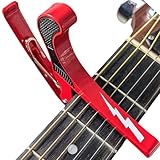
Overview: This budget-friendly capo targets beginner to intermediate players with its eye-catching lightning bolt design and straightforward spring-loaded mechanism. It promises quick key changes without finger strain, emphasizing rock aesthetics alongside basic functionality for both acoustic and electric 6-string guitars.
What Makes It Stand Out: The White Lightning design is unapologetically bold, appealing to players wanting to make a visual statement. The over-handled spring clamp is designed for one-handed operation, while the “anaconda grip” marketing suggests strong tension to prevent fret buzz, addressing a common complaint with budget capos.
Value for Money: Extremely affordable, this capo offers essential functionality at a fraction of premium brand prices. It’s an excellent entry point for beginners or a serviceable backup for experienced players. While build quality won’t match aerospace metals, the price-to-performance ratio is solid for casual use.
Strengths and Weaknesses: Strengths include low cost, distinctive aesthetics, quick one-handed operation, and strong clamping force. It’s lightweight and functional for basic needs. Weaknesses: unknown brand reputation, potentially inconsistent quality control, non-adjustable tension, and the flashy design may not suit all players or instruments. Durability concerns with heavy touring use.
Bottom Line: A solid choice for beginners or as a spare. Buy it for the rock-and-roll vibe and decent performance, but serious musicians should consider it a secondary option rather than a primary tool.
9. Aroma Classical Guitar Capo Exclusive for Nylon Strings Wide Neck Guitars Quick Release

Overview: Specifically engineered for classical guitars, this Aroma capo addresses the unique challenges of wide, flat necks and nylon strings. Using the same aerospace zinc alloy as their adjustable model, it combines targeted design with premium materials for classical purists who refuse to compromise.
What Makes It Stand Out: The custom-contoured clamp is precisely shaped for classical guitar necks, ensuring even pressure distribution across the wider fretboard. The ergonomic trigger design and high-tension steel spring provide reliable one-handed operation while maintaining the delicate balance needed for nylon strings without causing damage.
Value for Money: For classical guitarists, this specialized tool offers excellent value. Generic capos often fail on wide necks, causing buzz or intonation issues. This purpose-built design prevents those problems, justifying its mid-range price through performance and instrument protection that universal capos can’t provide.
Strengths and Weaknesses: Strengths include perfect classical neck fit, ergonomic handling, protective high-density silicone pads, and durable zinc alloy construction. The quick-release mechanism is smooth and reliable. Weaknesses: limited versatility—it’s not suitable for standard steel-string guitars. Non-adjustable tension may not suit all classical neck thicknesses. Slightly heavier than some competitors.
Bottom Line: An essential accessory for serious classical players. The tailored design solves problems universal capos can’t address. If you play nylon strings, this should be your go-to choice.
10. Guitar Capo for Acoustic, Classical, Electric Guitars, Ukulele, Mandolin, Banjo, and other string musical instruments, Quick Release, Memory Silicone Pad, Buzzing-Free (Black & Silver)

Overview: This universal capo aims to be the Swiss Army knife of capos, accommodating everything from guitars to ukuleles and mandolins. Constructed from aircraft-grade aluminum with a quick-release trigger, it’s designed for multi-instrumentalists seeking versatility without sacrificing performance across their entire collection.
What Makes It Stand Out: Unmatched versatility is the headline feature—one capo for your entire instrument collection. The memory silicone pad conforms to different neck profiles, while adjustable tension ensures proper pressure across various string counts and neck widths. The sleek profile won’t interfere with playing or bending.
Value for Money: Exceptional value for players owning multiple instruments. Instead of buying separate capos, one purchase covers all needs. The build quality exceeds expectations at this price point, making it economical and practical for diverse musical setups while maintaining professional standards.
Strengths and Weaknesses: Strengths include incredible versatility, lightweight aluminum build, protective padding, quick-release mechanism, and adjustable tension. It handles 6 and 12-string guitars equally well. Weaknesses: jack-of-all-trades design means it’s not perfectly optimized for any single instrument type. The generic aesthetic lacks personality, and clamp size may be awkward on smaller instruments like ukuleles.
Bottom Line: The ultimate utility capo for multi-instrumentalists. If you juggle guitars, ukulele, and mandolin, this single tool replaces several specialized capos. Highly recommended for versatility seekers.
Why Speed Matters: The Busker’s Dilemma
When you’re performing on the street, momentum is currency. Every second of dead air is an invitation for potential donors to keep walking. A quick-release capo isn’t just about convenience; it’s about maintaining the hypnotic flow that transforms casual listeners into paying fans. The mechanical advantage these devices provide can shave precious seconds off your between-song transitions, but more importantly, they eliminate the fumbling, the “hang on a sec” apologies, and the dreaded dropped capo that rolls into the storm drain.
The psychology is simple: audiences subconsciously equate professionalism with fluidity. When you execute a key change in one smooth motion—clamping the capo while making eye contact and launching into the next intro—you’re sending a message. You’re not just another hobbyist killing time; you’re a practiced performer worth their attention and their spare change. This perception directly impacts your take-home at the end of the day.
The Anatomy of a Quick-Release Capo
Understanding what makes these tools tick helps you spot quality from gimmickry. At its core, a quick-release capo consists of three critical components: the clamping arm, the tension mechanism, and the protective padding. The clamping arm provides the structural backbone, typically arching over the neck to grip the strings against the fretboard. The tension mechanism—your spring, lever, or cam system—generates the clamping force. The padding, often overlooked, is what stands between your prized instrument and permanent damage.
The geometry of these components determines everything from speed to tonal clarity. A well-designed capo distributes pressure evenly across all six strings while requiring minimal hand strength to operate. The pivot point’s location, the arm’s curvature, and the spring’s compression ratio all work in concert. Cheaper models often skimp on this engineering, resulting in uneven pressure that chokes your tone or requires Herculean grip strength to engage.
Trigger vs. Lever: Understanding Mechanism Types
The quick-release world splits into two philosophical camps: trigger-style mechanisms and lever-action designs. Trigger capos operate like a clothespin on steroids—squeeze the handles, the jaws open; release, and a spring snaps them shut. They’re intuitive, universally understood, and excel at pure speed. The downside? You’re at the mercy of the factory-set spring tension, which can be too aggressive for delicate vintage necks or too weak for high-action setups.
Lever-action capos, conversely, offer more nuanced control. These typically feature a cam or toggle system where you position the capo and flip a lever to lock it in place. Some models include micro-adjustment screws that let you fine-tune the pressure. While this adds a half-second to your operation, it gives you the ability to dial in the perfect tension for your specific instrument. For buskers juggling multiple guitars or unconventional tunings, this adjustability can be worth its weight in gold.
Key Features That Define Performance
Beyond the basic mechanism, several performance characteristics separate the professional-grade tools from the gas-station impulse buys. The first is the pressure-to-closure ratio—how much hand force you need to apply versus how securely the capo holds. Premium designs use mechanical advantage to make operation effortless, crucial during a three-hour set when your hands are already cramping from barre chords.
Another overlooked factor is the capo’s profile height when installed. A bulky capo sticks up from your neck like a skyscraper, interfering with your fretting hand’s movement and potentially catching on your palm during vigorous strumming. Low-profile designs hug the neck, staying out of your way but often sacrificing some ease of handling. The sweet spot depends on your playing style—aggressive strummers need sleekness, while fingerstyle players might prioritize grip comfort.
Spring Tension and Pressure Distribution
The internal spring is the heart of any quick-release capo, and its characteristics dramatically affect both your instrument’s health and your tone. Too much tension, and you’ll pull strings sharp and accelerate fret wear. Too little, and you’ll get buzzing, muted notes, and embarrassing dead strings mid-verse. Quality manufacturers use calibrated springs with consistent compression rates, but even these vary.
Progressive spring designs are the gold standard for buskers. These springs increase their resistance exponentially rather than linearly, meaning the initial squeeze is easy but the final clamping force is substantial. This gives you better control and prevents the jarring “snap” that can yank strings out of tune. When testing a capo, press each string individually behind the capo—you should feel uniform resistance with no soft spots.
Material Matters: From Zinc Alloy to Titanium
The material composition affects everything from weight to durability to tone transmission. Die-cast zinc alloy dominates the budget to mid-range market. It’s cheap to produce and reasonably strong, but it’s dense and can corrode if the finish chips. For the touring busker, aircraft-grade aluminum offers a better weight-to-strength ratio and superior corrosion resistance.
At the premium end, stainless steel and even titanium capos exist. These materials provide exceptional durability and the stiffness needed for precise pressure distribution. The trade-off is weight—a steel capo can feel like an anchor on your headstock after hours of wear. Some innovative designs use hybrid construction: steel where strength is needed, aluminum where weight savings matter. The finish matters too; powder coating lasts longer than paint, and bare metal can oxidize in humid climates.
Padding Perfection: Protecting Your Fretboard
That soft rubber pad pressing against your strings isn’t just a cushion—it’s a critical tone-shaping component. Cheap silicone pads can harden over time, developing permanent indentations that create pressure points. Premium capos use proprietary rubber compounds that maintain elasticity and resist taking a set. The pad’s texture matters: too smooth, and it can slip; too grippy, and it might grab strings during removal.
Thickness is another variable. Thicker pads conform better to uneven frets and string heights but can absorb more high-frequency vibrations, subtly dulling your tone. Thinner pads transmit more string energy but show wear faster. Some capos feature replaceable pads, which is a huge plus for working musicians. A worn pad is often the first failure point, and being able to swap in a fresh one for a few bucks beats buying a whole new capo.
Size and Weight: Balancing Portability with Function
When you’re hoofing it from subway platform to park bench, every ounce in your gig bag matters. A capo that lives on your headstock becomes part of your instrument’s weight balance. Heavy capos can make your guitar neck-dive, especially on acoustics with already marginal balance. But featherweight capos sometimes feel flimsy and can be harder to manipulate quickly with cold or sweaty hands.
The form factor also affects storage. Does it clip neatly to your headstock or soundhole when not in use? Does it have a low enough profile to stay out of your way? Some buskers prefer capos that can be stored on a mic stand clip, keeping them instantly accessible without adding neck weight. Consider your entire performance ecosystem, not just the capo in isolation.
One-Handed Operation: The True Test
Here’s where theory meets reality: can you operate it cleanly with one hand while holding a chord shape? This is the busker’s litmus test. A capo that requires two hands might as well be a screw-adjust model for all the good it does you mid-song. The handle geometry must accommodate various grip styles—some players use their thumb and index finger like a pincer, others palm the whole thing.
Test this before buying. Hold your guitar in playing position and try to remove the capo from your headstock, apply it at the second fret, then move it to the seventh fret—all with your fretting hand alone. The motion should feel natural, not require finger gymnastics. Pay attention to how the handles feel: are they contoured or just bare metal edges? After dozens of changes per set, ergonomics become crucial.
Compatibility Concerns: Not All Necks Are Created Equal
That capo that works flawlessly on your main acoustic might be a disaster on your travel guitar or the baritone you occasionally bring out. Neck profiles vary wildly: from vintage V-shapes to modern C-profiles, from 1-11/16" nut widths to 2" behemoths. A capo designed for a specific radius can leave outer strings buzzing on a different neck.
Quick-release capos with fixed curvature work best on standard radiused fretboards common on modern acoustics. However, if you play a classical guitar with its flat fingerboard, you’ll need a capo designed for that geometry. Some versatile models include adjustable radius pads or flexible rubber that conforms to different curves. For buskers who switch between instruments, this adaptability isn’t just nice—it’s essential.
Radiused vs. Flat Fretboards
The radius of your fretboard—the subtle curve from the bass to treble side—directly impacts capo performance. Most steel-string acoustics feature a 12" to 16" radius, while electrics can be flatter (often 9.5" to 12"). Classical and many folk guitars use completely flat fretboards. A capo designed for a 12" radius will apply uneven pressure on a flat board, typically crushing the middle strings while leaving the outer ones under-pressed.
Some quick-release capos attempt to solve this with a “floating” pad system where independent rubber segments adjust to each string. While clever, these add complexity and potential failure points. Others use a slightly curved but flexible pad that can flatten under pressure. The most reliable solution is often the simplest: choose a capo designed for your primary instrument’s radius, and accept that it may be suboptimal on others.
String Gauge and Action Considerations
If you’re a busker who uses heavy-gauge strings for volume and projection, standard capo springs might not generate enough pressure. Light strings, conversely, can be pulled sharp by overly aggressive springs. Your action height compounds this—high action requires more clamping force to prevent buzzing, while low action needs a gentler touch to avoid choking notes.
This is where adjustable tension becomes invaluable. Some lever-style quick-release capos include a thumbwheel that lets you increase or decrease spring preload. For trigger-style fans, a few manufacturers offer different spring weights you can swap out. Know your setup: measure your string gauge and action at the 12th fret. If you’re running 13-56 strings with 4mm action, you need a capo that can handle that load without turning your tone into a sitar imitation.
Durability for the Road-Worn Warrior
Your gear takes a beating. It gets tossed in a backpack, dropped on concrete, rained on, and baked in the sun. A capo that works perfectly in the climate-controlled music store might develop sticky springs in humid coastal air or have its padding crack in desert dryness. The pivot points are typically the first failure—cheap rivets loosen, bushings wear out, and suddenly your quick-release becomes a quick-fail.
Look for capos with sealed mechanisms or minimal moving parts. Stainless steel pivot pins outperform aluminum rivets, and self-lubricating polymer bushings last longer than metal-on-metal contact. The finish should be robust enough that scratches don’t lead to corrosion. For the ultimate in durability, some pro-grade capos use titanium hardware at stress points, though this pushes prices into the triple digits.
Weather Resistance and Temperature Fluctuations
Buskers perform in conditions that would make most musicians pack up and go home. Rapid temperature changes cause metal components to expand and contract, affecting spring tension and clamping force. A capo that’s perfect at 70°F might buzz incessantly at 40°F or choke your strings at 90°F. Materials with low thermal expansion coefficients—like certain aluminum alloys—maintain more consistent performance.
Humidity is another silent killer. Springs can rust internally even if the exterior looks fine, leading to sticky operation or sudden failure. Some manufacturers now use silicone-treated springs or coat internal components with dry lubricant. If you busk near the ocean or in rainy climates, consider this non-negotiable. That faint squeak you hear when engaging the capo? That’s the sound of corrosion beginning.
Price vs. Performance: Finding Your Sweet Spot
The quick-release capo market spans from $5 gas station novelties to $150 titanium sculptures. For buskers, the sweet spot typically lies in the $25-60 range, where you get professional-grade mechanisms without boutique pricing. Below $15, you’re gambling with your tone and your instrument’s finish. Above $75, you’re paying for marginal gains and exotic materials that matter more for studio perfectionists than street performers.
Consider cost-per-use. A $40 capo that lasts three years of daily busking costs about three cents per day. A $10 capo that fails in six months and potentially damages your $800 guitar is no bargain. The hidden cost of cheap capos is downtime—when it breaks mid-set, you’re either improvising without it or packing up early. For a working musician, that’s lost income.
The Investment Perspective for Serious Buskers
If you’re pulling regular gigs and your capo is as essential as your picks, view it as professional equipment rather than an accessory. The difference between a $30 and $60 capo often isn’t just durability—it’s consistency. Premium models hold their tension better, apply pressure more evenly, and operate smoothly after thousands of cycles. They’re also more likely to have replaceable parts, extending their lifespan indefinitely.
Some professional buskers maintain two identical capos: one on the instrument and one in reserve. This redundancy might seem excessive until you’re halfway through a lucrative Saturday afternoon set and your main capo’s spring decides to retire. At $40-50 each, two quality capos still cost less than most guitar pedals and are infinitely more critical to your core sound.
Pro Techniques for Seamless Key Changes
Having the right tool is only half the battle; mastering the technique completes the equation. The most efficient buskers develop muscle memory for capo placement that becomes as automatic as chord changes. Start by practicing the motion slowly: remove from storage position, position at target fret, engage mechanism, check tuning, and be ready to play—all without looking. Speed comes from repetition, not force.
The placement itself matters. Position the capo directly behind the fret wire, not in the middle of the fret space. This minimizes the length of vibrating string behind the capo, reducing the chance of buzzing and intonation issues. Apply it with a firm, decisive motion—hesitation leads to partial engagement and tuning disasters. Some players lightly pluck each string as they engage the capo, using auditory feedback to confirm proper seating.
The “Flip and Clip” Method
Developed by veteran street performers, this technique stores the capo on your headstock flipped upside-down (padding facing out). When you need it, you grip it by the clamping arm, flip it 180 degrees in one motion, and clip it onto the neck. This eliminates the awkward re-gripping that slows you down. It requires a capo with symmetrical handles and enough clearance to fit over your headstock’s thickness.
Practice this motion until it becomes reflexive. Start with the capo on the first fret, then move it to the third, fifth, and seventh frets in sequence, returning it to the headstock between each placement. Your goal is to make each transition in under two seconds while maintaining your strumming pattern. Record yourself on video to spot inefficiencies—you’ll be surprised how much motion is wasted in unnecessary finger adjustments.
Strategic Gear Placement and Accessibility
Smart buskers treat their performance space like a cockpit. Everything has a designated home that allows blind retrieval. If you store your capo on your headstock, ensure it doesn’t interfere with your left hand’s movement up the neck. Some players prefer a magnetic clip attached to their mic stand or a carabiner on their belt loop. The key is consistency—never change storage location mid-performance.
Consider secondary storage for when you’re using the capo. A small pouch on your guitar strap or a clip on your music stand (if you use one) gives you a place to stash the capo during songs where you don’t need it. This prevents the clumsy “hold it in my teeth” maneuver that looks unprofessional and risks dropping it. Your gear should work for you, not create additional problems to solve.
Maintenance and Care for Longevity
Even the best quick-release capo degrades without proper maintenance. The constant cycle of compression and release gradually fatigues the spring. Dust and grime from your hands infiltrate the pivot points. The padding accumulates oxidation from metal strings. A monthly maintenance routine takes five minutes but can double your capo’s usable life.
Start with a visual inspection. Look for cracks in the padding, corrosion at the pivot, and any loosening of fasteners. Test the spring tension—it should feel consistent from the first squeeze to the hundredth. Check that the clamping surfaces remain parallel when engaged; if they’re skewing, the pivot is wearing unevenly. Catching these issues early lets you address them before they become performance-killing failures.
Cleaning and Lubrication Routines
Use a dry toothbrush to remove debris from the mechanism. For sticky pivots, a tiny drop of dry Teflon lubricant works wonders—avoid oil-based lubes that attract dust. Clean the padding with a slightly damp cloth and mild soap; string residue builds up and can harden the rubber. If the pad is removable, take it off for thorough cleaning.
For internal springs, a blast of compressed air can dislodge grit. If you busk in salt-air environments, wipe down the entire capo with a cloth lightly dampened with fresh water after each session to prevent salt crystallization. Store it in a small pouch rather than loose in your case where it can bang against other metal objects. These simple habits separate the pros from the amateurs.
When to Retire Your Trusty Capo
Knowing when to replace a capo is as important as knowing how to use one. If you notice persistent buzzing on specific strings that proper placement doesn’t fix, the pad has likely developed uneven wear. A spring that feels “mushy” or doesn’t return to full open position is fatigued and unreliable. Visible corrosion, especially on internal components, is a red flag—by the time you can see it, it’s already affecting performance.
Don’t wait for catastrophic failure. A capo that lets you down during a prime Saturday afternoon set costs you more in lost tips than a replacement would have. Many professional buskers follow the “two-year rule” even for quality capos: if it’s seen daily use for 24 months, it’s earned retirement. Keep the old one as a backup, but don’t trust your income to worn-out gear.
Common Pitfalls That Slow You Down
Even with the perfect capo, certain habits can sabotage your speed. The most common is inconsistent storage—sometimes on the headstock, sometimes in your pocket, sometimes clipped to your strap. This forces your brain to search rather than act. Another mistake is “testing” the capo after placement by squeezing it again. Trust your technique; double-squeezing wastes time and can actually shift the capo out of optimal position.
Another trap is using a capo that’s too tight for your setup. Many players assume more pressure equals better tone, but excessive tension pulls strings sharp and makes the capo harder to remove quickly. Find the minimum pressure needed for clean notes and stick with it. Finally, avoid capos with decorative elements—rhinestones, bulky logos, or awkward shapes might look cool but create handling issues when you’re moving fast.
Frequently Asked Questions
1. Can I use a quick-release capo on my 12-string guitar? Yes, but you need a model specifically designed for 12-string necks. The wider neck and doubled courses require a longer clamping arm and more robust spring tension. Standard 6-string capos will leave the outer octave strings buzzing. Look for models with at least 2.25" of clearance and adjustable tension to handle the increased string load.
2. Why does my quick-release capo pull my guitar out of tune? This typically indicates excessive spring tension or poor pressure distribution. Try placing the capo directly behind the fret and applying it with a swift, decisive motion. If the problem persists, your capo’s padding may be too hard or its spring too strong. Consider switching to a model with adjustable tension or a thinner, more compliant pad.
3. How do I prevent my capo from scratching my guitar’s neck? Always inspect the padding before each use. Grit can embed in the rubber and act like sandpaper. Wipe the pad clean regularly and check for any hard spots or cracks. Some players apply a thin strip of clear protective film to the back of their neck where the capo contacts it, though this shouldn’t be necessary with quality gear.
4. Is there a quick-release capo that works for both acoustic and electric guitars? Yes, several models feature adjustable radius pads that can conform to both radiused electric necks and flatter acoustic boards. However, the ideal tension differs between instruments. Your best bet is a lever-style capo with micro-adjustment, allowing you to dial in the right pressure for each guitar rather than relying on a one-size-fits-all spring.
5. My capo squeaks when I engage it. How do I fix this? The squeak usually comes from dry metal-on-metal contact at the pivot. Apply a tiny amount of dry lubricant—graphite or Teflon-based—to the pivot pin. Work the mechanism several times to distribute it. Avoid WD-40 or oil-based products that attract dust. If the squeak persists, the bushing may be worn and need replacement.
6. How long should a quality quick-release capo last with daily busking use? With proper maintenance, a mid-range to premium capo ($30-60) should reliably perform for 2-3 years of daily use. The padding typically wears first, followed by spring fatigue. Professional buskers often replace theirs every 18-24 months as preventive maintenance, keeping the old one as a backup.
7. Can I modify a standard capo to make it quick-release? While inventive players have attempted this, it’s not practical. The conversion requires precise engineering of the pivot geometry and spring rates that are difficult to achieve with hand tools. You’re better off investing in a purpose-built quick-release model. The time and risk to your instrument far outweigh the cost savings.
8. What’s the best way to store a capo when I’m not using it? For maximum speed, store it on your headstock or a dedicated mic stand clip. This keeps it accessible and develops consistent muscle memory. If you must store it off-instrument, use a small pouch attached to your strap or belt loop—never loose in a bag where it can be damaged or lost. Consistency is key for rapid retrieval.
9. Do quick-release capos work with alternative tunings like DADGAD? Absolutely, and they’re often more valuable in altered tunings where open-string drones are crucial. The same principles apply: even pressure and proper placement. Some tunings with uneven string tensions may require a capo with adjustable tension to prevent pulling certain strings sharper than others. Test thoroughly before performing.
10. Why do some quick-release capos cost over $100? Are they worth it? Premium pricing reflects exotic materials (titanium, stainless steel), precision manufacturing tolerances, replaceable components, and extensive R&D. For most buskers, the performance gains above $60 are incremental. However, if you’re a full-time performer whose income depends on reliability, the extended lifespan and consistency of a top-tier capo can justify the investment. Think of it as professional insurance.
See Also
- 10 Must-Have Trigger Capos for Buskers Who Swap Keys Mid-Song in 2026
- 10 Banjo Capos for Old-Time Two-Finger Pickers Who Capo at 2nd Fret
- 10 Aluminum Capos Under 1 oz for Fast Bluegrass Changes
- 10 Low-Profile Electric Capos for Shredders Who Play High Up the Neck
- Stop Key-Switch Delays: 10 Banjo Capos for Fast Bluegrass Sessions in 2026