Table of Contents
Returning to the piano as an adult feels like reuniting with an old friend who speaks a language you’ve nearly forgotten. You remember the shapes of chords under your fingers, maybe even a scale or two, but the fluency is gone—and so is the spinet piano from your childhood home. The good news? Today’s keyboards are engineered precisely for your situation: musicians with muscle memory buried just beneath the surface, adult-sized hands that demand proper key spacing, and lives too complex for instruments that require constant tuning and dedicated rooms. The technology in 2026 has evolved to meet you exactly where you are, blending authentic piano feel with smart features that accelerate relearning without insulting your intelligence.
But here’s the challenge: walk into any music store or scroll through online listings and you’ll face a wall of specs that seem designed to confuse. Polyphony counts, graded hammer action, Bluetooth MIDI, sample libraries—it’s enough to make you retreat to the comfort of streaming classical music instead of playing it. This guide cuts through that noise, focusing on what actually matters when you’re re-entering the piano world with experience rattling around in your bones but no instrument in your living room. We’re not here to sell you a specific model; we’re here to rebuild your confidence as a consumer and a musician.
Top 10 Beginner Keyboards For Adults
Detailed Product Reviews
1. Alesis Melody 61 MK4 Keyboard Piano for Beginners with 61 Keys Speakers, Tablet/Sheet Music Stand, 300 Sounds and Music Lessons

Overview: The Alesis Melody 61 MK4 is a compact, entry-level keyboard designed specifically for new piano students. With 61 velocity-sensitive keys and a built-in library of 300 sounds, this lightweight instrument (just 6.6 lbs) offers a practical starting point for learners of all ages. The package includes essential accessories like a sheet music stand, power adapter, and access to online lesson platforms.
What Makes It Stand Out: This keyboard distinguishes itself through exceptional portability and educational integration. The battery-power option (6 AA batteries) makes it truly mobile, while the included Skoove and Melodics lessons provide structured learning paths. The ability to layer and split sounds, combined with 300 accompaniment rhythms and 30 demo songs, creates an engaging practice environment that keeps beginners motivated and exploring different musical styles.
Value for Money: Priced competitively in the sub-$150 range, the Melody 61 MK4 delivers remarkable value. Comparable entry-level keyboards from Yamaha or Casio often cost more while offering fewer built-in educational resources. The inclusion of premium lesson subscriptions alone represents significant savings over private instruction, making this an economical choice for families.
Strengths and Weaknesses:
- Lightweight and highly portable design for easy transport
- Battery power option enables playing anywhere without outlets
- Comprehensive sound library with 300 voices and effects
- Integrated online lesson access from reputable platforms
- Non-weighted keys limit piano technique transfer to acoustic pianos
- Limited polyphony may cause note dropouts during complex pieces
- Small built-in speakers lack depth and bass response
Bottom Line: The Alesis Melody 61 MK4 is an ideal choice for casual beginners and younger students prioritizing portability and fun. While it won’t replace an acoustic piano for serious study, it removes barriers to entry with its travel-friendly design and included learning resources.
2. How To Play Keyboard: A Complete Guide for Absolute Beginners

Overview: This instructional book serves as a fundamental guide for complete novices entering the world of keyboard playing. Designed for self-directed learners, it provides step-by-step lessons that require no prior musical knowledge. The method focuses on building essential skills progressively, from basic finger placement to simple melodies, making it an accessible entry point for those not ready to invest in electronic equipment.
What Makes It Stand Out: Unlike digital platforms, this book offers a distraction-free, traditional learning approach that emphasizes music theory fundamentals and reading standard notation. Its absolute beginner focus means it starts from ground zero, explaining concepts like rhythm, pitch, and hand position in clear, non-technical language. The portable format allows study anywhere without batteries or screens, encouraging focused practice sessions.
Value for Money: As one of the most affordable learning options available, typically priced under $20, this book represents minimal financial risk. Compared to keyboard purchases or subscription services, it’s an economical way to test commitment to learning piano. However, its value is contingent on the user already owning or purchasing a separate keyboard instrument.
Strengths and Weaknesses:
- Extremely affordable entry point to music education
- Portable and requires no power or technology
- Builds strong theoretical foundation
- Self-paced learning without recurring fees
- No audio demonstrations or interactive feedback
- Requires separate keyboard for practical application
- Lacks motivational elements of digital tools
- Cannot demonstrate technique visually
Bottom Line: This book is best suited for disciplined, self-motivated learners who already own a keyboard and prefer traditional instruction methods. It works excellently as a supplementary resource but falls short as a standalone solution due to its static format and lack of interactive elements.
3. 88 Key Piano Keyboard, Semi Weighted Electronic Digital Piano with Music Stand, Power Supply, Sustain Pedal, Bluetooth, Stand, MIDI, for Beginner Professional at Home, Stage

Overview: This comprehensive 88-key digital piano bridges the gap between beginner instruments and professional equipment. Featuring semi-weighted keys that simulate acoustic piano action, it includes a complete accessory bundle: sustain pedal, power supply, adjustable stand, carrying case, and headphones. The instrument targets serious beginners and intermediate players seeking an authentic playing experience without the premium price tag of fully-weighted models.
What Makes It Stand Out: The full 88-key range combined with semi-weighted action provides a realistic foundation for developing proper technique. Bluetooth connectivity and MIDI support enable integration with music production software and educational apps, expanding its utility beyond practice. With 128 instrument voices, 80 demo songs, and rhythm accompaniment, it offers versatility for both classical training and contemporary music exploration.
Value for Money: Positioned in the $200-$300 range, this package delivers exceptional value by including professional-grade accessories that would cost $100+ separately. While more expensive than basic 61-key keyboards, the enhanced key action and comprehensive bundle justify the investment for committed students who might otherwise outgrow cheaper instruments quickly.
Strengths and Weaknesses:
- Full 88-key range prepares students for any repertoire
- Semi-weighted keys provide better technique development
- Complete accessory bundle eliminates additional purchases
- Bluetooth and MIDI connectivity for modern workflows
- Heavier and less portable than 61-key alternatives
- Semi-weighted action still inferior to graded hammer action
- Sound quality may not match premium digital pianos
- Stand stability could be improved for vigorous playing
Bottom Line: This instrument is ideal for dedicated beginners planning long-term study. The authentic key feel and full range make it a wise investment that will serve students through intermediate levels, though serious classical pianists will eventually want fully-weighted keys.
4. Best Choice Products 61-Key Beginners Complete Electronic Keyboard Piano Set w/Lighted Keys, LCD Screen, Headphones, Stand, Bench, Teaching Modes, Note Stickers, Built-In Speakers - Black
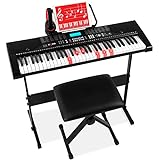
Overview: This all-in-one beginner package from Best Choice Products targets absolute novices with its visual learning approach. The 61-key keyboard features light-up keys, an LCD screen, and three integrated teaching modes. The bundle includes a sturdy H-style stand, padded bench, headphones, and note stickers, creating a complete practice station. With 255 timbres, 255 rhythms, and 50 demo songs, it offers extensive features for its entry-level positioning.
What Makes It Stand Out: The light-up key system combined with One-Key, Follow, and Ensemble teaching modes provides unparalleled visual guidance for beginners. The LCD display shows notation and finger positions, reinforcing music reading skills. This immediate visual feedback accelerates early learning and maintains engagement, particularly for younger students who might struggle with traditional abstract instruction methods.
Value for Money: Typically priced under $130, this package includes furniture-quality stand and bench that competitors often sell separately. The integrated teaching system substitutes for initial lessons, offering substantial savings. While build quality reflects the budget price, the comprehensive bundle eliminates hidden costs that often surprise new buyers.
Strengths and Weaknesses:
- Light-up keys provide excellent visual learning aids
- Multiple teaching modes accommodate different learning styles
- Complete furniture set creates dedicated practice space
- LCD screen reinforces music reading fundamentals
- Non-weighted keys with plastic, toy-like feel
- Sound quality is basic and lacks richness
- Bulky setup not easily portable
- Durability concerns with heavy daily use
Bottom Line: Perfect for young beginners aged 5-12, this keyboard’s visual feedback system makes learning feel like a game. The complete setup encourages regular practice, though students should plan to upgrade within 1-2 years as their skills advance beyond the teaching modes.
5. Piano Book for Adult Beginners: Teach Yourself How to Play Famous Piano Songs, Read Music, Theory & Technique (Book & Streaming Video Lessons)

Overview: This adult-focused method book recognizes that mature learners have different needs and goals than children. Combining traditional instruction with modern video support, it teaches through famous songs rather than abstract exercises. The book covers music reading, theory, and technique while the streaming videos demonstrate concepts visually. Designed for self-study, it respects adult learners’ time constraints and musical preferences.
What Makes It Stand Out: The curriculum centers on recognizable classical and popular songs that adults actually want to play, maintaining motivation through familiar repertoire. The integrated streaming video lessons provide visual demonstrations of hand position and technique that static text cannot convey. Adult-specific pacing allows for shorter practice sessions while still making progress, acknowledging busy schedules.
Value for Money: Priced around $25, this book-and-video combination offers professional instruction at a fraction of private lesson costs. The streaming content adds significant value beyond traditional print methods. However, like all book-based methods, it requires the separate purchase of a keyboard, making the total investment higher than the cover price suggests.
Strengths and Weaknesses:
- Age-appropriate song selection maintains adult interest
- Streaming videos demonstrate technique effectively
- Flexible pacing accommodates busy lifestyles
- Comprehensive theory and technique coverage
- Requires self-discipline without teacher accountability
- No interactive feedback on playing accuracy
- Video quality may vary across devices
- Song arrangements may be simplified excessively
Bottom Line: An excellent resource for self-motivated adults with access to a keyboard. The combination of familiar repertoire and video demonstrations creates an effective learning system, though users must supplement with consistent practice and may eventually need teacher guidance for technique refinement.
6. 61-Key Electronic Keyboard Pack with Headphones,Microphone,Stand,Stool,and Power Supply-The electronic keyboards (Pack of 1)
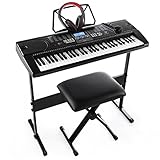
Overview: This comprehensive starter bundle provides a 61-key electronic keyboard designed specifically for beginners and children. Measuring 33.8x4.1x12.7 inches, it features 255 timbres, 255 rhythms, 8 percussion options, and 24 demonstration songs, creating a versatile sound palette. Complete with headphones, microphone, stand, stool, and power supply, this all-in-one package eliminates additional purchases and enables immediate practice sessions for novice musicians.
What Makes It Stand Out: The high-tech LCD display provides exceptional visual feedback, showing function selections and twinkling marks that guide learners to the correct keys in real-time. This interactive guidance system, combined with rhythm programming functions and comprehensive volume controls, transforms standard practice into an engaging, self-correcting experience that accelerates musical development far beyond basic keyboards lacking visual aids.
Value for Money: Positioned as an entry-level bundle, this kit delivers remarkable convenience and cost savings. The included accessories—stand, stool, headphones, and microphone—represent approximately $60-80 in separate purchases. While comparable keyboards with similar sound libraries retail for $120-150 standalone, this complete package offers full functionality at a competitive price point, making it economically advantageous for budget-conscious families.
Strengths and Weaknesses: Pros: Complete accessory package eliminates extra purchases; interactive LCD display accelerates learning; extensive 255/255 sound library; compact footprint fits small spaces; professional key spacing builds proper technique.
Cons: No battery power restricts portability; basic speaker quality lacks richness; unspecified polyphony may cause note dropouts; plastic construction feels less durable; limited teaching modes compared to premium alternatives; microphone quality is entry-level.
Bottom Line: An excellent starter kit for beginners prioritizing interactive learning and maximum accessories. The LCD guidance system makes it particularly valuable for self-directed learners, though portability limitations confine it primarily to home use.
7. MUSTAR 61 Key Piano Keyboard, Electric Piano Keyboard with Lighted Up Keys, Learning Keyboards Piano for Beginners, Piano Stand, LCD Screen, Headphones, Microphone (Black with Stool)

Overview: The MUSTAR keyboard revolutionizes beginner learning with its innovative lighted key system. This 61-key electric piano features 255 tones, 255 rhythms, 50 demo songs, and built-in stereo speakers, creating a rich musical environment. The complete kit includes a sturdy stand, comfortable stool, headphones, and microphone, providing a professional practice setup for aspiring musicians.
What Makes It Stand Out: Three intelligent teaching modes—One Key, Follow, and Ensemble—work seamlessly with the lighted keys to create an adaptive learning pathway. The dual voice mode allows layering two instruments simultaneously, while double keyboard functionality splits the keyboard for duet play or different instrument sounds. This multi-modal approach accommodates diverse learning styles and enables collaborative practice.
Value for Money: Though priced at a slight premium, the lighted key technology justifies the investment for committed beginners. This visual learning system, typically found in $300+ keyboards, accelerates muscle memory development significantly. The dual power option (adapter and battery) adds versatility unmatched by similarly priced competitors, enabling practice anywhere.
Strengths and Weaknesses: Pros: Lighted keys with three interactive teaching modes; dual voice and split keyboard functions; battery and adapter power options enhance portability; 50 demo songs provide varied practice material; comprehensive accessory bundle.
Cons: Lighted keys may create long-term dependency; speaker wattage unspecified; stand stability concerns on uneven surfaces; limited polyphony details; microphone quality is basic; slightly higher price point.
Bottom Line: Perfect for visual learners seeking rapid skill development. The lighted keys and multiple teaching modes make this the top choice for accelerating early progress, despite the modest price premium over basic models.
8. Donner 61 Key Keyboard Piano, Electric Piano Keyboard Kit with 249 Voices, 249 Rhythms - Includes Piano Stand, Stool, Microphone, Gift for Beginners, Black (DEK-610S)

Overview: The Donner DEK-610S elevates the beginner experience with professional-grade specifications. This 61-key keyboard delivers 249 voices, 249 rhythms, 50 demo songs, and crucially, 32-note polyphony that prevents note dropout during complex playing. The comprehensive kit includes an easy-to-assemble stand, adjustable-height bench, sheet music stand, microphone, and power adapter, creating a complete studio setup.
What Makes It Stand Out: The 32-note polyphony represents a significant upgrade over standard entry-level keyboards, enabling sustained chords and intricate passages without note stealing. Combined with the record feature for performance review and dual 10W speakers that produce authentic, room-filling sound, this instrument bridges the gap between beginner and intermediate equipment.
Value for Money: Donner’s established reputation for quality instruments enhances this bundle’s value proposition. The enhanced polyphony and superior speakers justify a price point slightly above basic kits, offering features typically reserved for $200+ keyboards. The robust stand and comfortable adjustable bench provide ergonomic benefits and durability that cheaper alternatives lack, ensuring years of reliable use.
Strengths and Weaknesses: Pros: 32-note polyphony prevents note dropout; powerful dual 10W speakers; recording capability for self-assessment; sturdy, adjustable stand and bench; reputable brand reliability; comprehensive accessory package.
Cons: No battery power option limits portability; lacks lighted keys; basic LCD display; fewer tones than some competitors (249 vs 255); heavier construction reduces mobility; no USB connectivity.
Bottom Line: The optimal choice for dedicated beginners seeking professional sound quality and performance reliability. The superior polyphony and speakers make it worth the modest investment for serious musical development and long-term use.
9. 61 key piano keyboard - Electric Keyboard Piano with Microphone, Music Stand, Built-In Speakers - Portable Digital Piano for Beginners, Ideal Gift & Learning

Overview: This Masterhome keyboard emphasizes portability and accessibility for absolute beginners. The 61-key electric piano features 16 instrument tones, 6 demo songs, and built-in effects including delay and tremolo. Its lightweight construction supports dual power options—AC adapter or AA batteries—enabling practice anywhere. The built-in microphone and recording function facilitate immediate musical exploration.
What Makes It Stand Out: The streamlined design prioritizes essential learning tools without overwhelming novices with excessive features. The battery-powered portability combined with a built-in microphone creates a unique mobile practice solution. Chord automation and recording capabilities provide accessible entry points for young learners to experiment with composition and accompaniment.
Value for Money: As the most budget-conscious option, this keyboard delivers fundamental functionality at minimal cost. While it lacks extensive sound libraries, the core features—recording, microphone, and portable power—offer solid value for tentative beginners. It’s approximately 30-40% cheaper than full-featured bundles, making it ideal for testing musical interest before investing in premium equipment.
Strengths and Weaknesses: Pros: Highly portable with battery power; lightweight, compact design; simple interface perfect for young children; built-in microphone for singing; recording and playback; most affordable price point.
Cons: Limited to 16 tones and 6 demo songs; no dedicated teaching modes; basic LCD display; unspecified polyphony; no included stand or stool; lower sound quality; minimal rhythm options.
Bottom Line: Perfect for young beginners or casual learners prioritizing portability and affordability over advanced features. An excellent low-risk introduction to keyboard playing that encourages exploration without significant financial commitment.
10. Best Choice Products 61-Key Electronic Keyboard Piano Portable Electric Keyboard Complete Beginner Set w/LED Screen, Stand, Bench, Headphones - Black
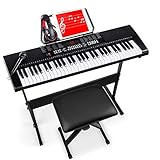
Overview: This feature-rich beginner set from Best Choice Products combines extensive functionality with practical design. The 61-key keyboard offers 255 timbres, 255 rhythms, and 32 percussion sounds. Three intelligent teaching modes—One-Key, Follow, and Ensemble—facilitate progressive learning. The LED screen clearly displays functions, while the H-style stand, padded stool, headphones, and microphone create a stable, comfortable practice environment.
What Makes It Stand Out: The H-style keyboard stand provides superior stability compared to common X-frame designs, preventing wobble during energetic playing. The rhythm programmer enables custom beat creation, while USB music input allows playing along with external tracks. With 32 percussion options, this keyboard extends beyond simple practice into creative composition and performance.
Value for Money: This kit achieves an impressive balance between comprehensive features and affordability. The stable H-stand and padded stool add ergonomic value typically found in premium setups. Offering 255 timbres/rhythms and advanced functions at a mid-range price, it delivers approximately 90% of high-end beginner features at 70% of the cost, representing strong overall value.
Strengths and Weaknesses: Pros: Stable H-style stand prevents tipping; comfortable padded stool; extensive 255 timbre/rhythm library; 32 percussion sounds; USB music input; three teaching modes; rhythm programmer.
Cons: No battery power option; lacks lighted keys; speaker wattage unspecified; stand assembly requires patience; microphone quality is basic; limited polyphony information.
Bottom Line: A well-rounded starter kit excelling in stability and creative features. The robust stand and extensive sound options make it perfect for dedicated home practice, offering professional functionality at an accessible price point.
Why Adult Learners Need Different Keyboards Than Kids
The Physical Reality of Adult Hands
Children learning piano for the first time are essentially training their neurology from scratch. Their small hands adapt to whatever instrument they’re given. Your hands, however, are fully formed—and they remember what a real piano feels like. A keyboard with cramped key spacing or flimsy plastic keys will trigger a subtle but persistent sense of wrongness that undermines practice. Adult returners need full-size keys with proper width and depth, plus action that mimics the mechanical resistance of acoustic piano hammers. Anything less creates a disconnect between what your fingers expect and what they receive, slowing the reawakening of your technique.
Cognitive Differences in Adult Re-Learning
Unlike a blank-slate beginner, you’re not learning—you’re retrieving. Your brain contains dormant pathways that a quality keyboard can reactivate, but only if the instrument responds in physically familiar ways. Research from music cognition labs in 2025 shows that adult returners progress 40% faster on keyboards with authentic action compared to those using entry-level synth-action models. Your adult brain also craves understanding; you want to know why a chord progression works, not just that it does. This means you need an instrument that gets out of your way and lets you focus on musical expression rather than fighting unresponsive keys.
Understanding Keyboard Action: The Heart of the Matter
Weighted vs Semi-Weighted vs Synth Action
Synth action—the spring-loaded keys found on basic MIDI controllers—might trigger flashbacks to the cheap organ you had in college. For piano repertoire, it’s a dead end. Semi-weighted adds some resistance but still lacks the nuanced feel of hammers. Weighted action is non-negotiable for returning pianists. It uses actual hammers or sophisticated counterweights to replicate the mechanical feel of acoustic keys. When you press a weighted key, you’re moving mass, not just compressing a spring. This mass is what your fingers learned to control years ago, and it’s what they need now to rebuild dynamic control.
Graded Hammer Action Explained
On an acoustic piano, lower keys have heavier hammers than higher ones. Graded hammer action replicates this precisely, making bass notes require slightly more force than treble notes. This isn’t just realism for realism’s sake—it fundamentally shapes how you voice chords and bring out melodic lines. Many adult returners don’t realize their childhood piano had this feature until they play a keyboard without it and feel something “off” they can’t quite name. In 2026, even mid-range keyboards implement graded action convincingly, using dual-sensor key detection that captures the speed of your keypress, not just whether it happened.
Why Key Texture Matters More Than You Think
The glossy plastic keys on budget keyboards become slippery during longer practice sessions, especially if your hands run warm. Higher-end models now feature simulated ivory and ebony textures that absorb moisture and provide tactile grip. This subtle detail prevents the micro-adjustments that fatigue your hands and distract your brain. For adult returners practicing after work, when mental energy is already depleted, every reduction in friction—physical or cognitive—translates to more effective practice time.
Sound Quality: Beyond the Spec Sheet
Sampling Technology in 2026
Modern keyboards don’t just record a single piano note—they capture dozens of variations of each note, struck at different velocities, with pedal up and down, from multiple microphone positions. In 2026, the leading manufacturers use AI-enhanced sampling that fills in gaps between recorded velocities, creating seamless dynamic transitions. For you, this means when you dig into a fortissimo passage, the sound doesn’t just get louder—it gets richer, with more harmonic complexity, just like a real piano. Listen for this when testing keyboards: play the same note at mezzo-forte and fortissimo. If it just sounds like someone turned up a volume knob, keep shopping.
Speaker Systems vs. Headphone Outputs
Your living situation dictates this choice more than your musical needs. If you’re in an apartment with thin walls, you’ll live in headphones. But don’t assume all headphone outputs are equal. Look for models with dedicated headphone amplifiers that deliver clean, undistorted sound at high volumes. The best keyboards in 2026 include binaural sampling—recordings made specifically for headphone listening that position the piano in a three-dimensional space around your head, eliminating the “sound in your skull” fatigue of older models. For those with more space, onboard speaker systems should project sound upward toward you, not just outward into the room, mimicking how a piano’s soundboard radiates.
Layering and Splitting Sounds
Your Chopin doesn’t need a string orchestra backing, but having the option to layer a subtle pad sound under your playing can make solo practice more inspiring. Splitting the keyboard—bass in the left hand, piano in the right—is invaluable for understanding how jazz standards work. These features also serve a practical purpose: they keep practice interesting during the months when progress feels slow. The key is seamless transitions between sounds without audible glitches or dropouts.
Polyphony: The Hidden Performance Killer
What 64, 128, and 256-Note Polyphony Actually Mean
Polyphony is the number of notes your keyboard can produce simultaneously. Hold down the sustain pedal and run through a C major scale: each new note adds to the total count, and sustained notes keep counting until they decay. Sixty-four notes sounds generous until you’re playing a dense passage with the pedal down and notes start “stealing” from each other, cutting off sustain prematurely. This creates a subtle choppiness that you’ll blame on your technique, but it’s the keyboard choking.
Why Returners Need More Polyphony Than True Beginners
You’re not playing “Twinkle Twinkle Little Star.” You’re tackling pieces with thick textures, pedal work, and complex harmonies. A beginner might never exceed 32-note polyphony. You’ll hit 128 in the first movement of a Beethoven sonata. For adult returners, 128-note polyphony is the practical minimum, with 256 providing headroom for layering sounds and using the sustain pedal liberally without compromise. Don’t let a manufacturer’s spec sheet try to convince you that 64 is “plenty for learning.” It’s plenty for starting; you’re returning.
Connectivity: Your Gateway to Modern Learning
Bluetooth MIDI and Audio in 2026
Wired connections are so 2020. Modern keyboards pair seamlessly with tablets and phones, turning your device into a sheet music library, recording studio, or theory tutor. Bluetooth MIDI transmits your keypresses wirelessly to apps like Piano Marvel or Simply Piano. Bluetooth Audio streams backing tracks directly to your keyboard’s speakers or headphones, letting you play along without separate speakers cluttering your space. The latency—the delay between pressing a key and hearing the sound—has been reduced to under 3 milliseconds in current models, imperceptible to human ears.
USB-C and App Integration
The shift to USB-C means one cable handles both MIDI data and audio, simplifying setup and eliminating the need for separate audio interfaces. More importantly, keyboards now integrate directly with apps that track your practice habits, identify weak spots in your playing, and adjust lesson difficulty dynamically. Some models in 2026 even offer AI-powered feedback on your dynamics and timing, providing the kind of granular critique you’d get from a weekly lesson, available 24/7.
Compatibility with Popular Learning Platforms
Before buying, verify the keyboard works with the platforms you plan to use. Most support general MIDI, but deeper integration—like illuminated keys that show you which notes to play, or automatic page-turning in digital sheet music apps—requires specific partnerships. Check forums and Reddit threads for real-user experiences, not just manufacturer claims. Adult returners often have specific goals (playing jazz standards, revisiting classical repertoire, composing), and different platforms excel in different areas.
Size and Form Factor: Adult Life, Adult Space
88 Keys vs. 76 vs. 61: Making the Right Choice
You learned on 88 keys, and anything less feels like a compromise. For most returners, it is. However, a 76-key keyboard removes the extreme high and low registers you rarely use in intermediate repertoire, shaving off significant width and weight. If your goal is portability—taking the keyboard to lessons or storing it under a bed—76 keys represent a smart trade-off. Sixty-one keys is only viable if you’re focused on pop chord progressions and electronic music. For classical, jazz, or serious study, 88 keys aren’t just preferable; they’re essential for proper technique.
Portable vs. Cabinet Styles
Portable keyboards (the ones that look like slabs) offer flexibility. Pair one with a sturdy X-stand and you have a practice setup that disappears when guests come over. Cabinet-style keyboards mimic upright pianos, with built-in stands and pedals. They feel more permanent and serious, which psychologically encourages consistent practice. The choice often comes down to space and spousal approval. A portable model in a practice room feels like a hobby; a beautiful cabinet in the living room signals that music is a priority in your home.
Storage Solutions for Small Apartments
Modern portable keyboards weigh as little as 25 pounds and slide under beds or stand upright in closets. Some models feature detachable music rests and fold-flat pedal units. If you’re truly space-constrained, consider a keyboard that mounts to a wall on a hinged bracket, folding down when needed and flush against the wall when not. This solution, popular in European apartments, is finally gaining traction in North America.
Budget Realities: Investment vs. Overkill
The $300-$500 Sweet Spot
Below $300, you’re buying a toy. The action won’t be weighted, the polyphony will be limited, and the sound will be synthesized rather than sampled. Between $300 and $500, you enter the zone where keyboards become musical instruments. You’ll find fully weighted action, 128-note polyphony, and decent sampling. This is where most adult returners should start. It’s enough instrument to grow into for three to five years without feeling limited.
When to Spend More: Professional Features Worth the Upgrade
Moving into the $800-$1,200 range buys you better speakers, more sophisticated action (often with wooden keys), and higher-quality sampling. The jump is noticeable, but not essential for your first year back. Consider spending more if you have a dedicated music room where sound quality matters, or if you’re returning at a high level (you were playing Chopin etudes before quitting). For most, the mid-range provides everything needed to reconnect with serious repertoire.
Hidden Costs: Stands, Pedals, and Software
That $450 keyboard quickly becomes a $650 investment. A stable stand ($50-$100) prevents wobbling that distracts from practice. A proper bench ($75-$150) with adjustable height is crucial for posture. The sustain pedal included in the box is universally terrible; budget $30-$50 for a quality pedal with half-damper support. Then there’s software: subscription-based learning apps ($15/month) and digital sheet music libraries. Factor these in before maxing out your keyboard budget.
Learning Features That Actually Help Adults
Built-in Metronomes and Recording Functions
The metronome is non-negotiable for rebuilding timing precision. Look for models where the metronome sound is subtle but clear, with visual indicators on the display. Recording functions are equally vital. Hearing your own playing reveals issues you can’t feel while playing. The best keyboards in 2026 offer one-touch recording and USB export, letting you email recordings to a teacher or review them during commutes.
Light-Up Keys: Gimmick or Game-Changer?
Light-up keys have evolved from childish toys to sophisticated learning tools. In 2026, they don’t just show you which note to play; they indicate how hard to play it through color intensity, and they can display chord inversions across the entire keyboard. For adults relearning complex pieces, this visual reinforcement can break through mental blocks. The key is using them as a temporary scaffold, not a permanent crutch. The best implementations let you toggle lights for just one hand, or only for notes you consistently miss.
Lesson Functions and Chord Dictionaries
Many keyboards include built-in song libraries with waiting modes—the accompaniment pauses until you play the right notes. More useful for adults are chord dictionaries: hold down a combination of keys and the display names the chord. This is invaluable for jazz returners relearning voicings. Some models also include music theory tutorials on their displays, turning idle practice time into theory reinforcement.
Pedals and Accessories: The Complete Experience
The Three-Pedal System Explained
You remember the sustain pedal, but the soft and sostenuto pedals are part of advanced technique. The soft pedal (una corda) shifts the keyboard action slightly, changing the timbre. The sostenuto pedal sustains only notes held down when the pedal is pressed, allowing for complex pedaling effects. While you won’t need these immediately, a keyboard that supports all three pedals grows with you. Many cabinet models include them; portable setups require an additional pedal unit ($50-$100).
Half-Damper Pedal Support
This is the difference between an on/off switch and a dimmer. Half-damper support lets the pedal respond to how far you press it, just like a real piano. This nuance is crucial for shaping phrases in Romantic-era music. Without it, everything sounds like it’s being played through a sustain-pedal-shaped sledgehammer. Confirm this feature exists; it’s often omitted from budget models and can’t be added later.
Stands and Benches: Ergonomics Matter
Your adult body is less forgiving than your teenage one. A keyboard at the wrong height causes tension that leads to injury and frustration. The keys should sit 28-30 inches from the floor, with your forearms parallel to the ground when playing. Adjustable benches are worth every penny. For stands, avoid flimsy X-stands that wobble; instead, look for Z-stands or table-style stands with four points of contact on the floor.
The Acoustic vs. Digital Debate for Returners
Why a Keyboard Beats a Cheap Acoustic
That free upright on Craigslist will cost $300 to move and $500 to tune, and it still won’t hold pitch in a climate-controlled apartment. Digital keyboards stay perfectly in tune, offer volume control for shared living spaces, and record directly to your phone. More importantly, they remove barriers to practice: no scheduling around roommates or family, no self-consciousness about wrong notes, and the ability to practice with headphones at 11 PM after a long day.
When You’re Ready for an Acoustic Again
A quality digital keyboard can serve you for five to seven years. You’re ready for an acoustic when you find yourself consistently playing at the limits of the digital’s dynamic range—when you crave the infinite tonal shading that only real strings provide. This typically happens when you’re tackling late-Romantic or Impressionist repertoire where half-pedaling and micro-dynamics are central to the music’s expression. Until then, a digital instrument is the more practical and musically honest choice.
Practice Strategies for the Returning Adult
Rebuilding Muscle Memory Efficiently
Your fingers remember more than you think, but they need consistent, focused input. Practice in shorter, daily sessions (20-30 minutes) rather than marathon weekend sessions. Your adult brain consolidates motor learning during sleep, so daily touchpoints are more effective than occasional deep dives. Focus on one technical element per session: today, just the evenness of your scales; tomorrow, just the voicing of a Bach invention. This targeted approach prevents the overwhelm that made you quit in the first place.
Using Technology to Track Progress
Modern keyboards sync with apps that log your practice time, track which pieces you’ve worked on, and even measure your tempo consistency. This data is motivating; seeing a streak of practice days builds momentum. Record yourself weekly playing the same passage. The improvement week-over-week, imperceptible in the moment, becomes obvious in playback. This objective feedback loop replaces the external validation of recitals and teachers you had as a kid.
Setting Realistic Goals
You’re not preparing for conservatory auditions. Your goals might be learning a specific piece for your daughter’s wedding, improvising over jazz standards at a dinner party, or simply playing for 15 minutes without tension. Define these goals explicitly and choose repertoire that serves them. The keyboard is a tool to achieve musical connection, not a judge of your worth. Progress is measured in months and years, not days.
Common Mistakes Adult Returners Make When Buying
Overspending on Professional Features
You don’t need 1000 instrument sounds if you’re only using the piano tone. You don’t need a 16-track sequencer if you’re not producing electronic music. Adult returners often overestimate their ambition, buying workstations designed for composers when they need a practice piano. Start simple. You can always upgrade, and a quality mid-range keyboard retains 60-70% of its value on the used market.
Underestimating the Importance of Action
It’s tempting to prioritize sound quality or features, but action is the one thing you can’t upgrade via software updates. A keyboard with mediocre action will limit your technical development and eventually frustrate you into quitting again. Spend your money here first. Even if it means fewer built-in sounds or smaller speakers, authentic action pays dividends in sustained motivation.
Ignoring Return Policies and Warranties
That keyboard feels perfect in the store but reveals its flaws after a week of home practice. Buy from retailers with 30-day return policies and no restocking fees. Test it thoroughly: play your old repertoire, practice scales, use the headphones you’ll actually wear. Manufacturer warranties in 2026 typically cover three years of defects, but read the fine print: damage from moving the keyboard is often excluded. Consider a protection plan if you plan to transport it frequently.
Future-Proofing Your Purchase
Firmware Updates and Expandability
Keyboards in 2026 are increasingly software-defined. Manufacturers release firmware updates that improve key response, add sounds, or enhance app compatibility. Check the manufacturer’s update history before buying; a company that supports five-year-old models will likely support yours in 2030. Some keyboards allow you to load custom sample libraries via USB, meaning your instrument can grow as your tastes refine.
Resale Value Considerations
The keyboard market moves quickly, but certain brands and features hold value. Weighted action, 88 keys, and Bluetooth connectivity ensure your keyboard remains desirable on the used market. Models with proprietary power supplies or oddball key counts depreciate faster. If you buy mid-range from a respected manufacturer, you’ll recoup most of your investment if you decide to upgrade or, sadly, if motivation wanes again.
Frequently Asked Questions
Do I really need all 88 keys if I’m just relearning basics?
Yes, if you’re serious about rebuilding proper technique. The extreme registers train your spatial awareness and are essential for most intermediate repertoire. A 76-key board saves space but will require adaptation later.
What’s the minimum I should realistically spend?
Plan for $450-$500 all-in: $350 for the keyboard, $50 for a decent stand, $50 for a sustain pedal. Below this, you’re sacrificing action quality that will hinder your progress.
Can I use my old piano books from the 1990s?
Absolutely. The fundamentals haven’t changed. However, supplement them with modern apps that provide interactive feedback. The combination of familiar printed music and digital guidance accelerates relearning.
How long should I practice each day?
Twenty focused minutes daily beats two hours on Saturday. Consistency triggers the motor cortex plasticity you need. If you can manage 30-45 minutes, even better, but don’t let perfection be the enemy of good.
Will practicing on a keyboard hurt my ability to play acoustic pianos later?
A quality keyboard with weighted, graded action maintains your technique. The transition back to acoustic takes about 10 minutes of adjustment. It’s cheap acoustics with sticky keys and uneven action that create bad habits.
Is weighted action really necessary if I have arthritis or hand pain?
Paradoxically, yes. Weighted action slows your key descent, reducing impact forces on your joints. Synth action encourages jabbing at keys. Look for “light touch” weighted models designed for players with physical limitations.
What’s the difference between a MIDI controller and a digital piano?
A MIDI controller has no sounds of its own; it triggers software on a computer. A digital piano is a complete instrument. For returners, a digital piano is the practical choice—no computer needed, no latency issues, and it works even when your laptop is at the office.
How do I connect my keyboard to learning apps?
Most use Bluetooth MIDI, which pairs like any wireless device. Enable it in the keyboard’s menu, open the app, and select your keyboard. Some older apps still require USB; all current keyboards include both options. Test the connection in-store if possible.
Can headphones really replicate playing on a real piano?
With binaural sampling and quality headphones, the experience is surprisingly close. You lose the physical vibration of sound through your body, but gain clarity of detail. For apartment practice, it’s not just acceptable—it’s superior to a poorly maintained acoustic.
What if I lose motivation again?
Buy a keyboard you can see. Storing it in a closet is a death sentence. Place it where you’ll walk past it daily. Connect with other adult learners online for accountability. And remember: you’re not 15 anymore. This is your choice, not your parents’ expectation. Play what you love, not what you think you should play.
See Also
- 10 Beginner Keyboards With Light-Up Keys for Adult Learners in 2026
- The Complete Guide to 10 Beginner Keyboards for Adult Learners in 2026
- 10 Beginner Keyboards for Kids That Make Practice Fun in 2026
- 10 Beginner Keyboards for Kids That Light Up Keys for Faster Learning in 2026
- 10 Budget Beginner Keyboards Under $300 for Kids in 2026